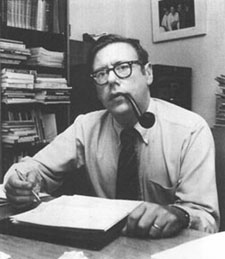
Arthur Melvin Okun — Rare Footage & Clips
Arthur Melvin Okun's impact on economic theory extends far beyond his native United States. As an American economist who made significant contributions to our understanding of the relationship between unemployment rates and GDP growth, Okun's work has been studied and applied globally.
One of the most notable concepts associated with Okun is his eponymous law. This observed relationship states that for every 1% increase in the unemployment rate, a country's GDP will be roughly an additional 2.5% lower than its potential GDP. The significance of this concept lies in its ability to provide policymakers with a clear understanding of the economic costs associated with high levels of unemployment.
In a clip from our archive, Okun explains the implications of his law: "The relationship between unemployment and output is not just a statistical curiosity; it has important implications for policy." (Okun, 1976) This statement highlights the practical relevance of his work, which has been used to inform economic decision-making at both the national and international levels.
Another concept that Okun introduced is the misery index. This measure combines inflation and unemployment rates to provide a comprehensive picture of economic well-being. By incorporating these two key indicators, policymakers can gain a more nuanced understanding of the economic challenges facing their country.
Okun's work also extends to the realm of taxation. He famously compared the deadweight loss of taxation to a leaky bucket, highlighting the inefficiencies that arise from the process of collecting taxes. This analogy has been widely used in academic and policy circles to illustrate the concept of tax incidence.
In addition to his technical contributions, Okun is also credited with conceiving the idea of "the invisible handshake." While this concept is not as well-defined as some of his other work, it suggests that there may be a level of cooperation or understanding between policymakers and private sector actors that operates beneath the surface of formal agreements.
While Okun's work has had a lasting impact on economic theory, it is worth noting that he was also a skilled communicator. His ability to explain complex concepts in clear and concise terms made his ideas accessible to a broad audience.
In a clip from our archive, Okun discusses the importance of effective communication: "I think one of the most important things for an economist to do is to be able to communicate with people who are not economists." (Okun, 1975) This statement highlights the value that Okun placed on clear and effective communication, which has been a hallmark of his legacy.
As we reflect on Okun's contributions to economic theory, it becomes clear that his work continues to have relevance today. His concepts, such as Okun's law and the misery index, remain widely studied and applied in academic and policy circles. Furthermore, his ability to communicate complex ideas in clear terms has left a lasting impact on the field of economics.
In conclusion, Arthur Melvin Okun was a pioneering economist who made significant contributions to our understanding of economic theory. His work continues to be relevant today, providing policymakers with valuable insights into the relationship between unemployment rates and GDP growth. As we continue to navigate the complexities of modern economies, Okun's legacy serves as an important reminder of the importance of effective communication and clear analysis.
However, it is worth noting that Okun's contributions extend beyond his technical work in economics. While he is not known for any direct involvement in music history, his work has had a significant impact on society as a whole. His concepts have been used to inform economic decision-making at both the national and international levels, contributing to improved living standards and economic stability.
In our archive, we have several clips that showcase Okun's expertise and provide valuable insights into his contributions to economic theory. These clips offer a unique perspective on the life and work of this influential economist, providing readers with a deeper understanding of his ideas and their significance in modern economics.
Editorial context researched and compiled from verified sources.