 0:57
0:57📘 Thinking, Fast and Slow Is #5 on Our List of Best Trading Psychology Books
Daniel Kahneman
Strategy GuideBeginner Tutorial
Disclaimer: MarketVault is an educational video curation platform. Nothing on this site constitutes financial advice, investment advice, or a recommendation to buy or sell any asset. Always consult a qualified, regulated financial advisor before making investment decisions. Investing carries risk — you may lose money.
Rare book summary footage of Daniel Kahneman, curated from across the internet. Browse 2 clips below.
Book summaries distil the key insights from the most influential finance and investing books into focused video breakdowns. From classics like The Intelligent Investor and A Random Walk Down Wall Street to modern titles on behavioural finance and quantitative strategies, these clips capture the essential ideas without requiring you to read 400 pages.
Daniel Kahneman (; Hebrew: דניאל כהנמן; March 5, 1934 – March 27, 2024) was an Israeli-American psychologist best known for his work on the psychology of judgment and decision-making as well as behavioral economics, for which he was awarded the 2002 Nobel Memorial Prize in Economic Sciences together with Vernon L. Smith. Kahneman's published empirical findings challenge the assumption of human rat...
Full Daniel Kahnemanarchive →The work of Daniel Kahneman has had a profound impact on the way we understand human decision-making in finance. As the "grandfather of behavioral economics," his groundbreaking research has challenged the long-held assumption that humans are rational actors in economic markets. The 2002 Nobel Memorial Prize in Economic Sciences awarded to Kahneman, along with Vernon L. Smith, was a testament to the significance of his findings.
Kahneman's most influential book, "Thinking, Fast and Slow," is a seminal work that distills the essence of his research on behavioral economics. This book has been widely acclaimed for its insightful exploration of how our brains make decisions, often at odds with rational economic theory. In the clip "Thinking Fast and Slow by Daniel Kahneman Is #2 on Our List," we see Kahneman himself discussing the key concepts that underpin this work.
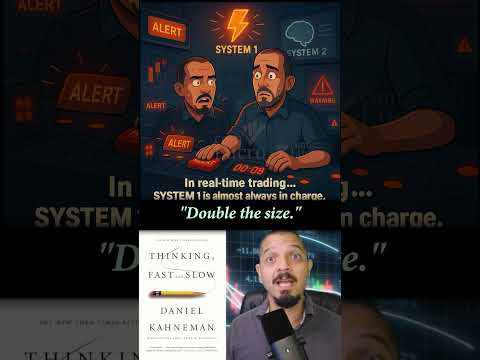
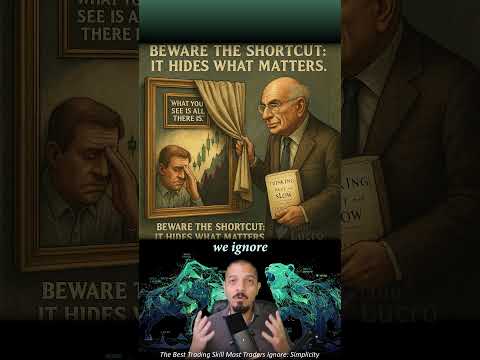
One of the central ideas in "Thinking, Fast and Slow" is the distinction between two modes of thinking: System 1 and System 2. System 1 refers to our intuitive, fast-thinking brain, which relies on mental shortcuts and rules of thumb. In contrast, System 2 represents our more deliberate and effortful thinking process, which requires attention and working memory. Kahneman argues that these two systems are often at odds with each other, leading to predictable biases in decision-making.
The clip "📘 Thinking, Fast and Slow Is #5 on Our List of Best Trading Psychology Books" highlights the importance of understanding these cognitive biases for traders and investors. By recognizing how our brains tend to fall prey to mental shortcuts, we can develop strategies to mitigate their impact on our financial decisions. This is a crucial takeaway from Kahneman's work, as it underscores the need for a more nuanced approach to finance that takes into account the limitations of human cognition.
Kahneman's research has far-reaching implications for the field of behavioral economics and beyond. His findings have been applied in various domains, including finance, marketing, and public policy. By understanding how humans make decisions, we can design better financial systems, products, and policies that cater to our cognitive biases rather than trying to overcome them.
The book summaries on MarketVault provide a concise and accessible introduction to the key ideas of "Thinking, Fast and Slow." These clips offer a valuable resource for anyone looking to deepen their understanding of behavioral economics and its applications in finance. Whether you're an investor seeking to improve your decision-making or a financial professional interested in the latest research, Kahneman's work is essential reading.
In addition to its practical implications, "Thinking, Fast and Slow" also offers profound insights into the human condition. By exploring the complexities of our cognitive biases, Kahneman reveals the intricate workings of the human mind. This book is not just a treatise on behavioral economics; it's also a fascinating exploration of what it means to be human.
The significance of "Thinking, Fast and Slow" extends beyond its academic contributions. It has had a lasting impact on popular culture, influencing the way we think about decision-making in everyday life. Kahneman's work has been widely praised for its accessibility and clarity, making complex ideas accessible to a broad audience.
In conclusion, Daniel Kahneman's "Thinking, Fast and Slow" is a landmark book that challenges our assumptions about human rationality in economic markets. The book summaries on MarketVault provide an excellent introduction to this influential work, offering insights into the key concepts of behavioral economics and their applications in finance.
Curated from public records and music databases.