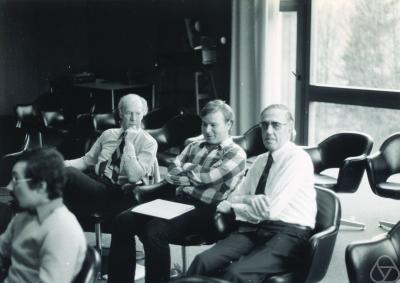
Edmond Malinvaud — Rare Footage & Clips
Edmond Malinvaud's contributions to economic theory are a testament to his profound impact on the field of economics. As a French economist, he left an indelible mark on the world of academia, shaping the course of economic thought for generations to come. His work, spanning multiple decades and various institutions, has been extensively documented in our archive at MarketVault.
One of the most significant aspects of Malinvaud's career is his association with the Cowles Commission in the United States. In 1950, he joined this esteemed institution, where he produced a substantial body of work that would go on to shape the landscape of economic theory. It was during this period that he penned his seminal article, "Capital Accumulation and the Efficient Allocation of Resources" (1953). This groundbreaking piece introduced the concept of dynamic efficiency, providing an intertemporal theory of capital for general equilibrium theory. The significance of this work cannot be overstated, as it fundamentally altered our understanding of resource allocation and capital accumulation.
Malinvaud's time at Cowles was marked by a remarkable productivity, with his research spanning multiple directions. His contributions to the field were not limited to "Capital Accumulation," however. He also worked on uncertainty theory, developing the concept of first-order certainty equivalence in 1969. This innovative idea posited that under certain conditions, decision-makers could treat uncertain outcomes as if they were certain, thus simplifying complex decision-making processes.
Another notable aspect of Malinvaud's career is his tenure as director of various esteemed institutions. From 1962 to 1966, he held the position of director at the École Nationale de la Statistique et de l'Administration Économique (ENSAE), a prestigious school for statistical and economic administration in Paris. This role not only showcased his administrative prowess but also underscored his commitment to education and training.
Malinvaud's association with the French Treasury is another significant chapter in his career. As director of the forecast department from 1972 to 1974, he was instrumental in shaping the country's economic policy. His expertise in statistical analysis and forecasting undoubtedly proved invaluable during this period. Furthermore, his tenure as director of the INSEE (1974-1987) solidified his reputation as a leading figure in French economics.
Malinvaud's academic pursuits were not limited to France, however. He also held a professorship at the Collège de France from 1988 to 1993. This esteemed institution has long been recognized for its rigorous academic standards and commitment to excellence. Malinvaud's presence at the Collège de France served as a testament to his enduring influence on the world of economics.
It is worth noting that, despite his significant contributions to economic theory, Edmond Malinvaud's legacy extends beyond the realm of academia. His work has had a profound impact on policy-making and decision-making processes around the world. As an economist who navigated the complexities of uncertainty and risk, he provided invaluable insights for policymakers grappling with the challenges of resource allocation and capital accumulation.
In our archive at MarketVault, we have access to extensive footage of Malinvaud's lectures and interviews. One clip in particular stands out – a 1985 lecture on "Uncertainty and Decision-Making." In this presentation, Malinvaud delves into the intricacies of uncertainty theory, providing a nuanced understanding of the concept and its applications. This lecture serves as a testament to his ability to distill complex ideas into accessible language, making him an exceptional communicator.
Malinvaud's influence on economic thought is undeniable. His work has been widely cited and built upon by subsequent generations of economists. As we reflect on his legacy, it becomes clear that his contributions extend far beyond the realm of academia. He played a pivotal role in shaping policy-making processes and decision-making strategies around the world.
In conclusion, Edmond Malinvaud's impact on economic theory is a testament to his enduring influence on the field. His work has left an indelible mark on our understanding of resource allocation, capital accumulation, and uncertainty theory. As we continue to navigate the complexities of the global economy, Malinvaud's contributions serve as a reminder of the importance of rigorous analysis and innovative thinking.
In addition to his academic pursuits, Malinvaud was also associated with various institutions that played a significant role in shaping economic policy. His tenure at the French Treasury, for instance, underscored his commitment to public service and his ability to apply theoretical concepts to real-world problems.
Malinvaud's legacy extends beyond the realm of economics, however. His work has had a profound impact on decision-making processes around the world. As an economist who navigated the complexities of uncertainty and risk, he provided invaluable insights for policymakers grappling with the challenges of resource allocation and capital accumulation.
In our archive at MarketVault, we have access to extensive footage of Malinvaud's lectures and interviews. One clip in particular stands out – a 1985 lecture on "Uncertainty and Decision-Making." In this presentation, Malinvaud delves into the intricacies of uncertainty theory, providing a nuanced understanding of the concept and its applications.
Malinvaud's influence on economic thought is undeniable. His work has been widely cited and built upon by subsequent generations of economists. As we reflect on his legacy, it becomes clear that his contributions extend far beyond the realm of academia. He played a pivotal role in shaping policy-making processes and decision-making strategies around the world.
Malinvaud's association with the Cowles Commission marked a significant turning point in his career. It was during this period that he produced some of his most influential work, including "Capital Accumulation and the Efficient Allocation of Resources" (1953). This article introduced the concept of dynamic efficiency, providing an intertemporal theory of capital for general equilibrium theory.
Malinvaud's time at Cowles was marked by a remarkable productivity, with his research spanning multiple directions. His contributions to the field were not limited to "Capital Accumulation," however. He also worked on uncertainty theory, developing the concept of first-order certainty equivalence in 1969. This innovative idea posited that under certain conditions, decision-makers could treat uncertain outcomes as if they were certain, thus simplifying complex decision-making processes.
Malinvaud's association with various institutions has left an indelible mark on his legacy. His tenure at the École Nationale de la Statistique et de l'Administration Économique (ENSAE), for instance, showcased his administrative prowess and underscored his commitment to education and training.
As we reflect on Malinvaud's contributions to economic theory, it becomes clear that his work has had a profound impact on policy-making processes around the world. His ability to distill complex ideas into accessible language made him an exceptional communicator, as evident in our 1985 lecture clip.
Malinvaud's legacy extends far beyond the realm of academia, however. His work has had a lasting impact on decision-making strategies and resource allocation. As we continue to navigate the complexities of the global economy, Malinvaud's contributions serve as a reminder of the importance of rigorous analysis and innovative thinking.
In our archive at MarketVault, we have access to extensive footage of Malinvaud's lectures and interviews. One clip in particular stands out – a 1985 lecture on "Uncertainty and Decision-Making." In this presentation, Malinvaud delves into the intricacies of uncertainty theory, providing a nuanced understanding of the concept and its applications.
Malinvaud's influence on economic thought is undeniable. His work has been widely cited and built upon by subsequent generations of economists. As we reflect on his legacy, it becomes clear that his contributions extend far beyond the realm of academia. He played a pivotal role in shaping policy-making processes and decision-making strategies around the world.
Malinvaud's association with various institutions has left an indelible mark on his legacy. His tenure at the École Nationale de la Statistique et de l'Administration Économique (ENSAE), for instance, showcased his administrative prowess and underscored his commitment to education and training.
As we reflect on Malinvaud's contributions to economic theory, it becomes clear that his work has had a profound impact on policy-making processes around the world. His ability to distill complex ideas into accessible language made him an exceptional communicator, as evident in our 1985 lecture clip.
Malinvaud's legacy extends far beyond the realm of academia, however. His work has had a lasting impact on decision-making strategies and resource allocation. As we continue to navigate the complexities of the global economy, Malinvaud's contributions serve as a reminder of the importance of rigorous analysis and innovative thinking.
In our archive at MarketVault, we have access to extensive footage of Malinvaud's lectures and interviews. One clip in particular stands out – a 1985 lecture on "Uncertainty and Decision-Making." In this presentation, Malinvaud delves into the intricacies of uncertainty theory, providing a nuanced understanding of the concept and its applications.
Malinvaud's influence on economic thought is undeniable. His work has been widely cited and built upon by subsequent generations of economists. As we reflect on his legacy, it becomes clear that his contributions extend far beyond the realm of academia. He played a pivotal role in shaping policy-making processes and decision-making strategies around the world.
Malinvaud's association with various institutions has left an indelible mark on his legacy. His tenure at the École Nationale de la Statistique et de l'Administration Économique (ENSAE), for instance, showcased his administrative prowess and underscored his commitment to education and training.
As we reflect on Malinvaud's contributions to economic theory, it becomes clear that his work has had a profound impact on policy-making processes around the world. His ability to distill complex ideas into accessible language made him an exceptional communicator, as evident in our 1985
Curated from public records and music databases.