0 views
Share this clip
Esteban Rossi-Hansberg: Forecasting Climate Change with Spatial Economics
Know someone who'd love this clip?
Share it with friends and fellow fans.
Share this clip
Disclaimer: MarketVault is an educational video curation platform. Nothing on this site constitutes financial advice, investment advice, or a recommendation to buy or sell any asset. Always consult a qualified, regulated financial advisor before making investment decisions. Investing carries risk — you may lose money.
Know someone who'd love this clip?
Share it with friends and fellow fans.
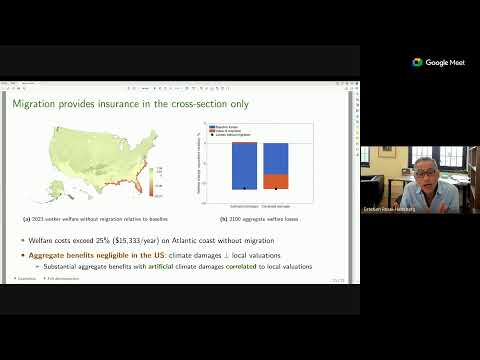
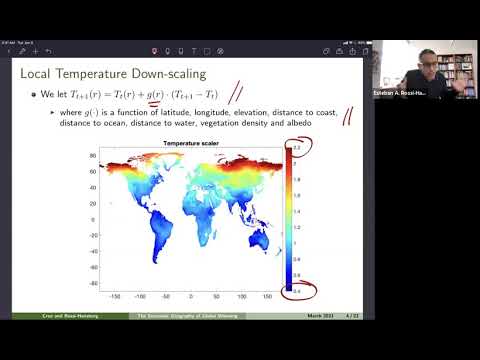
Esteban Rossi-Hansberg is the Theodore A. Wells '29 Professor of Economics at Princeton University. He performs research in macroeconomics, international trade, and urban and regional economics. He has been appointed the Glen A. Lloyd Distinguished Service Professor at the University of Chicago where he will join the faculty of the Kenneth C. Griffin Department of Economics in the Summer of 2021. In Prof. Rossi-Hansberg’s recent paper “The Economic Geography of Global Warming,” he seeks to evaluate the economic consequences of global warming using a dynamic model with high spatial resolution. The paper is a perfect example of the kind of spatial economics research that Prof. Rossi-Hansberg pioneers and is particularly recognized for in the economics discipline. This podcast interview focuses on Prof. Rossi-Hansberg’s research in spatial economics and uses this climate change paper as an entry point to explain the methodologies and frameworks in spatial economics. Spatial economics differs from conventional macro models by recognizing the singularities in space and how the local dimension influences agent decisions. Spatial frictions and shocks can impact the growth of local economies quite dramatically. These questions matter because it’s important to figure out whether changing these frictions could actually spur more growth or will merely lead to static reallocation effects. Issues such as migration frictions, factor adjustment costs, investment decisions on a local level, and climate change are hard problems to solve. Spatial economics cares about the distribution of expectations and effects, and agents in different areas may care differently about the distributions in the future and that will influence their decisions. Prof. Rossi-Hansberg constructs these dynamic models that can provide a much more nuanced view on these economic questions. For example, previous models of the economic impact of climate change rely on loss functions that track aggregate output as a function of temperature and other global variables. Importantly, these models do not incorporate local variation and behavioral responses, and therefore do not accurately model the reality of economic adaptation to climate change. Prof. Rossi-Hansberg’s paper “The Economic Geography of Global Warming” aims to resolve the shortcomings of these previous models by using an integrated assessment model (IAM) with rich spatial data that looks at interactions between regions to show how the effects of global warming on production and migration are large, worrying, and unequal. He gives a detailed overview on how he goes about constructing an IAM and in particular, combining scientific modeling with socioeconomic analysis. He also gives examples of policy implications of the IAM and how they are used to come to practical policy decisions. The paper notes that climate change does not affect regions in a homogenous fashion. Rather, certain regions of the world are impacted at different degrees than others – from welfare losses of 10% to gains of 15%. Prof. Rossi-Hansberg argues that these differences manifest in differences in productivity and amenities, with places like North America and Russia reaping those benefits. In contrast, the Global South and Europe suffer. The model also implies that the benefits of carbon taxes without a forthcoming abatement technology is relatively small as it merely delays carbon use and thus does not eliminate long-run temperature changes. However, carbon taxes can become very beneficial if there’s an abatement technology that can emerge by 2100. In other words, with abatement, carbon tax not only flattens the curve but also leads to significant welfare gains. At the end of the interview, we also ask Prof. Rossi-Hansberg about his journey in economics academia over the years and why he decided to move from Princeton to the University of Chicago in the coming summer. He praises America’s economics academia for being a treasure that allows one to freely think and push for frontier research, and he explains that his decision to join UChicago stems from a desire to explore new challenges in life after spending years at Princeton.
Esteban Rossi-Hansberg (born July 16, 1973) is a Mexican-American economist currently the Glen A. Lloyd Distinguished Service Professor in the Kenneth C. Griffin Department of Economics at the University of Chicago. Until June 2021, he was the Theodore A. Wells '29 Professor of Economics at Princeton University. He performs research in macroeconomics, international trade, and urban and regional economics. His research focuses on the internal structure of cities, the distribution of economic acti...
More about Esteban Rossi-Hansberg→Added
 1:15:41
Esteban Rossi-Hansberg
 1:01:32
Esteban Rossi-Hansberg
 1:00:21
Esteban Rossi-Hansberg
 1:18:08
Esteban Rossi-Hansberg
 1:19:22
Esteban Rossi-Hansberg
 43:59
43:59Esteban Rossi-Hansberg
 59:16
59:16Esteban Rossi-Hansberg
1:15:41Esteban Rossi-Hansberg
 1:35:18
 1:58
1:58 1:00
1:00 45:29
45:29Ajit Ranade