0 views
Share this clip
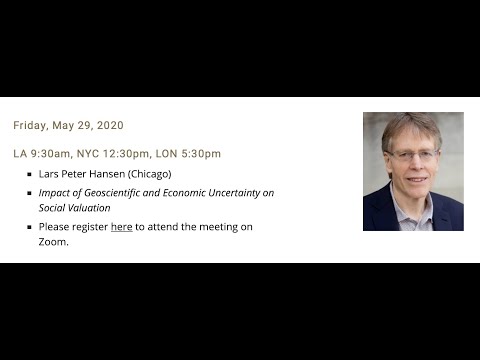
Lars Peter Hansen, the Nobel laureate in Economics (Master Thoughts)
Know someone who'd love this clip?
Share it with friends and fellow fans.
Share this clip
Disclaimer: MarketVault is an educational video curation platform. Nothing on this site constitutes financial advice, investment advice, or a recommendation to buy or sell any asset. Always consult a qualified, regulated financial advisor before making investment decisions. Investing carries risk — you may lose money.
Know someone who'd love this clip?
Share it with friends and fellow fans.
Lars Peter Hansen is an esteemed economist and statistician, known for his contributions to econometrics, macroeconomics, and financial economics. He was awarded the Nobel Memorial Prize in Economics in 2013. His main research findings include the following four areas: First, the Generalized method of moments (GMM). Hansen is best known for his work on the generalized method of moments, which is now widely used in econometrics. Hansen applies the GMM method to analyze economic models in numerous fields including labor economics, international finance, finance and macroeconomics. This method has been widely adopted in economics, and other fields, and applications where fully specifying, and solving a model of a complex economic environment is unwieldy, or otherwise impractical. Hansen showed how to exploit moment conditions (e.g. relations where conditional expectations are known to be zero at true parameter values) to construct reasonable, reliable estimators (for example having desirable statistical properties, such as consistency, asymptotic normality, and efficiency within the class of all asymptotic normal estimators) with less stringent maintained model assumptions than needed for maximum likelihood estimation. Second, the Dynamic stochastic general equilibrium (DSGE) models. Hansen has made significant contributions to the development of DSGE models, which are widely used to analyze macroeconomic issues. He has shown how to estimate these models using Bayesian methods, and has also developed methods for assessing their accuracy. Third, the Financial economics. Hansen has made contributions to the understanding of asset pricing and financial markets, including the development of tests for rational expectations and the efficient markets hypothesis. His current collaborative research develops and applies methods for pricing the exposure to macroeconomic shocks, over alternative investment horizons, and investigates the implications of the pricing of long-term uncertainty. Fourth, the Macroeconomic policy analysis. Hansen is also a distinguished macroeconomist, focusing on the linkages between the financial sector and the macroeconomy. He has worked on a number of important topics in macroeconomic policy, including the design of monetary policy, the analysis of business cycles, and the effects of fiscal policy on the economy. He focused on the difference between risk and uncertainty (also known as Knightian uncertainty), and on the measurement of so-called systemic risk, its role in the 2008 financial crisis, and how it should be contained during the post-Great Recession recovery. He frequently speaks publicly on the need to address uncertainty in the policy-making process. Overall, Hansen's work has had a major impact on the field of economics, and has laid the foundation for much of the research that is being done today in macroeconomics and financial economics. On October 14, 2013, Hansen, with Eugene Fama and Robert Shiller, was awarded the Nobel Memorial Prize in Economic Sciences. The award cited their "empirical analysis of asset prices."
Lars Peter Hansen (born 26 October 1952 in Urbana, Illinois) is an American economist. He is the David Rockefeller Distinguished Service Professor in Economics, Statistics, and the Booth School of Business, at the University of Chicago and a 2013 recipient of the Nobel Memorial Prize in Economics. Hansen is best known for his work on the generalized method of moments. He is also a distinguished macroeconomist, focusing on the linkages between the financial sector and the macroeconomy. His curren...
More about Lars Peter Hansen→Added
 2:07
2:07 0:22
0:22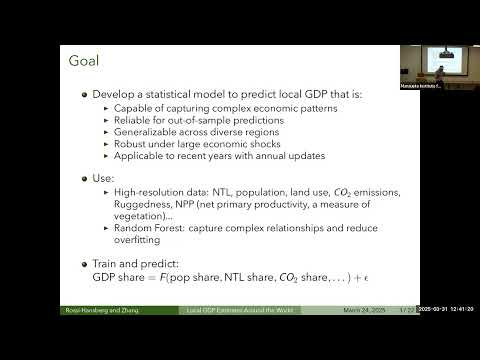 1:00:56
Esteban Rossi-Hansberg
 0:51
0:51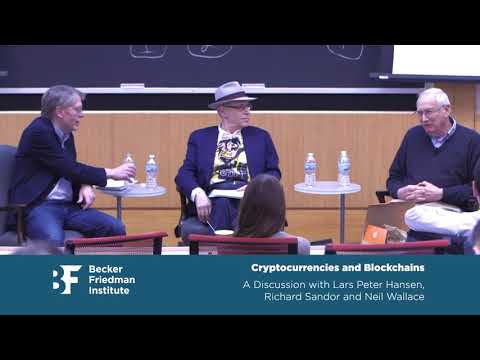 58:43
58:43Lars Peter Hansen
 43:01
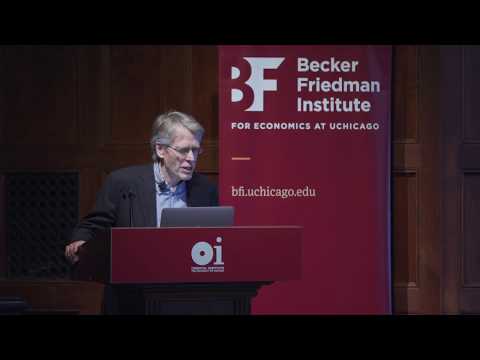
43:01Lars Peter Hansen
 1:16:22
Lars Peter Hansen
 1:05:10
Lars Peter Hansen