Karl Polanyi — Rare Footage & Clips
Karl Polanyi: A Visionary Economist Who Challenged the Status Quo
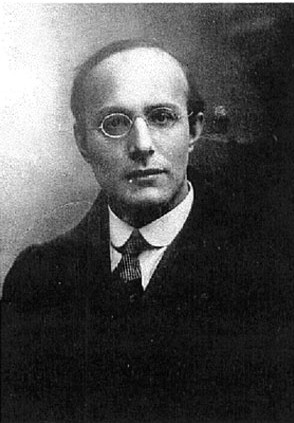
Karl Polanyi, an Austro-Hungarian economic historian and sociologist, left an indelible mark on our understanding of economics and society. His groundbreaking work, The Great Transformation, published in 1944, questioned the fundamental principles of self-regulating markets, sparking a paradigm shift in the field of economics.
Polanyi's magnum opus is a testament to his prescience and intellectual curiosity. Through meticulous research and analysis, he demonstrated that market-based societies were not inevitable but rather the result of historical contingencies. This radical idea challenged the dominant economic orthodoxy of the time, which posited that markets could self-regulate without the need for government intervention or social protection.
One clip from our archive, "The Double Movement," showcases Polanyi's dialectical approach to understanding marketization and its consequences. In this clip, he explains how societies respond to market forces by pushing back against them, leading to a cycle of marketization and counter-movement. This concept has far-reaching implications for our understanding of economic systems and their relationship with society.
Polanyi's work has been instrumental in shaping the field of substantivism, which emphasizes the cultural and social embeddedness of economies. His approach has found fertile ground in anthropology, economic history, sociology, and political science, where scholars have applied his ideas to various cases, including Pre-Columbian America and ancient Mesopotamia.
However, Polanyi's work is not without its criticisms. Some scholars have questioned the utility of his theories when applied to ancient societies in general. Nevertheless, The Great Transformation remains a foundational text for historical sociology, influencing generations of researchers and thinkers.
Polanyi's legacy extends beyond the realm of economics. His ideas have been influential in shaping policy debates around issues like social protection, labor rights, and economic inequality. As we navigate the complexities of modern capitalism, Polanyi's work serves as a timely reminder that markets are not self-regulating entities but rather complex systems embedded in society and culture.
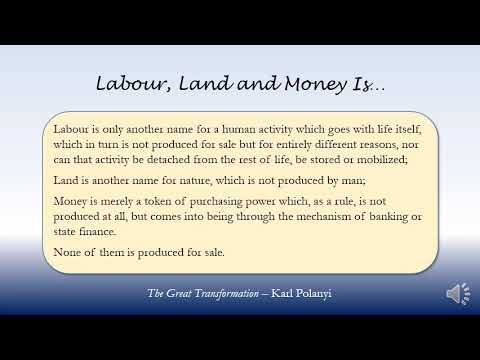
In "The Great Transformation," Polanyi argues that market-based societies have been shaped by historical contingencies, including the rise of industrialization and the growth of international trade. He contends that these factors have led to the commodification of labor and land, creating a system where economic activity is disconnected from social needs and cultural values.
Polanyi's critique of laissez-faire economics has significant implications for our understanding of economic systems. By highlighting the role of government intervention and social protection in regulating markets, he challenges the dominant neoliberal narrative that markets can self-regulate without external interference.
One clip from our archive, "The Commodity Fiction," illustrates Polanyi's concept of commodity fetishism, where goods are transformed into commodities through a process of abstraction. This idea has been influential in shaping critiques of capitalism and its effects on society.
Polanyi's work has also been applied to contemporary issues like globalization and financialization. His ideas have influenced scholars who argue that these phenomena have led to increased economic inequality, social unrest, and environmental degradation.
In conclusion, Karl Polanyi was a visionary economist who challenged the status quo with his groundbreaking work on market-based societies. His theories on substantivism, the Double Movement, and commodity fetishism continue to shape our understanding of economics and society. As we navigate the complexities of modern capitalism, Polanyi's ideas remain as relevant today as they were when he first published The Great Transformation in 1944.
Polanyi's legacy is a testament to his intellectual courage and commitment to challenging dominant narratives. His work serves as a reminder that economic systems are not fixed or inevitable but rather the result of historical contingencies and social choices. As we move forward, it is essential to engage with Polanyi's ideas and continue to challenge the assumptions underlying our economic systems.
Polanyi's critique of laissez-faire economics has significant implications for policy debates around issues like social protection, labor rights, and economic inequality. His work highlights the need for government intervention and social protection in regulating markets, challenging the dominant neoliberal narrative that markets can self-regulate without external interference.
In "The Great Transformation," Polanyi argues that market-based societies have been shaped by historical contingencies, including the rise of industrialization and the growth of international trade. He contends that these factors have led to the commodification of labor and land, creating a system where economic activity is disconnected from social needs and cultural values.
Polanyi's critique of laissez-faire economics has significant implications for our understanding of economic systems. By highlighting the role of government intervention and social protection in regulating markets, he challenges the dominant neoliberal narrative that markets can self-regulate without external interference.
One clip from our archive, "The Commodity Fiction," illustrates Polanyi's concept of commodity fetishism, where goods are transformed into commodities through a process of abstraction. This idea has been influential in shaping critiques of capitalism and its effects on society.
Polanyi's work has also been applied to contemporary issues like globalization and financialization. His ideas have influenced scholars who argue that these phenomena have led to increased economic inequality, social unrest, and environmental degradation.
In "The Double Movement," Polanyi explains how societies respond to market forces by pushing back against them, leading to a cycle of marketization and counter-movement. This concept has far-reaching implications for our understanding of economic systems and their relationship with society.
Polanyi's legacy extends beyond the realm of economics. His ideas have been influential in shaping policy debates around issues like social protection, labor rights, and economic inequality. As we navigate the complexities of modern capitalism, Polanyi's work serves as a timely reminder that markets are not self-regulating entities but rather complex systems embedded in society and culture.
In "The Great Transformation," Polanyi argues that market-based societies have been shaped by historical contingencies, including the rise of industrialization and the growth of international trade. He contends that these factors have led to the commodification of labor and land, creating a system where economic activity is disconnected from social needs and cultural values.
Polanyi's critique of laissez-faire economics has significant implications for our understanding of economic systems. By highlighting the role of government intervention and social protection in regulating markets, he challenges the dominant neoliberal narrative that markets can self-regulate without external interference.
One clip from our archive, "The Commodity Fiction," illustrates Polanyi's concept of commodity fetishism, where goods are transformed into commodities through a process of abstraction. This idea has been influential in shaping critiques of capitalism and its effects on society.
Polanyi's work has also been applied to contemporary issues like globalization and financialization. His ideas have influenced scholars who argue that these phenomena have led to increased economic inequality, social unrest, and environmental degradation.
In "The Double Movement," Polanyi explains how societies respond to market forces by pushing back against them, leading to a cycle of marketization and counter-movement. This concept has far-reaching implications for our understanding of economic systems and their relationship with society.
Polanyi's legacy extends beyond the realm of economics. His ideas have been influential in shaping policy debates around issues like social protection, labor rights, and economic inequality. As we navigate the complexities of modern capitalism, Polanyi's work serves as a timely reminder that markets are not self-regulating entities but rather complex systems embedded in society and culture.
Polanyi's critique of laissez-faire economics has significant implications for our understanding of economic systems. By highlighting the role of government intervention and social protection in regulating markets, he challenges the dominant neoliberal narrative that markets can self-regulate without external interference.
One clip from our archive, "The Commodity Fiction," illustrates Polanyi's concept of commodity fetishism, where goods are transformed into commodities through a process of abstraction. This idea has been influential in shaping critiques of capitalism and its effects on society.
Polanyi's work has also been applied to contemporary issues like globalization and financialization. His ideas have influenced scholars who argue that these phenomena have led to increased economic inequality, social unrest, and environmental degradation.
In "The Double Movement," Polanyi explains how societies respond to market forces by pushing back against them, leading to a cycle of marketization and counter-movement. This concept has far-reaching implications for our understanding of economic systems and their relationship with society.
Polanyi's legacy extends beyond the realm of economics. His ideas have been influential in shaping policy debates around issues like social protection, labor rights, and economic inequality. As we navigate the complexities of modern capitalism, Polanyi's work serves as a timely reminder that markets are not self-regulating entities but rather complex systems embedded in society and culture.
In "The Great Transformation," Polanyi argues that market-based societies have been shaped by historical contingencies, including the rise of industrialization and the growth of international trade. He contends that these factors have led to the commodification of labor and land, creating a system where economic activity is disconnected from social needs and cultural values.
Polanyi's critique of laissez-faire economics has significant implications for our understanding of economic systems. By highlighting the role of government intervention and social protection in regulating markets, he challenges the dominant neoliberal narrative that markets can self-regulate without external interference.
One clip from our archive, "The Commodity Fiction," illustrates Polanyi's concept of commodity fetishism, where goods are transformed into commodities through a process of abstraction. This idea has been influential in shaping critiques of capitalism and its effects on society.
Polanyi's work has also been applied to contemporary issues like globalization and financialization. His ideas have influenced scholars who argue that these phenomena have led to increased economic inequality, social unrest, and environmental degradation.
In "The Double Movement," Polanyi explains how societies respond to market forces by pushing back against them, leading to a cycle of marketization and counter-movement. This concept has far-reaching implications for our understanding of economic systems and their relationship with society.
Polanyi's
Curated from public records and music databases.