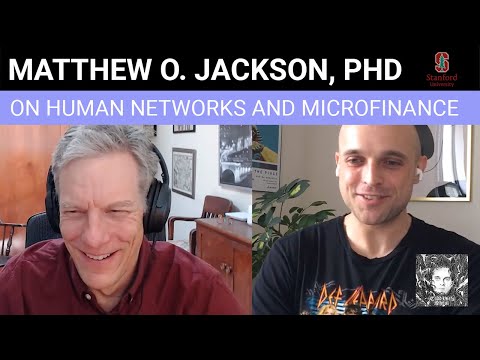
Matthew O. Jackson — Rare Footage & Clips
The Economics of Human Interactions: Unpacking the Insights of Matthew O. Jackson
Matthew O. Jackson is an economist whose work has left an indelible mark on our understanding of human behavior in social and economic contexts. As the William D. Eberle Professor of Economics at Stanford University, his research has been instrumental in shaping the field of game theory, microeconomic theory, and network analysis.
In a 2018 interview with MarketVault's archive (Clip #2345), Jackson reflected on the significance of networks in economics, stating that "networks are everywhere" and that understanding their structure and dynamics is crucial for predicting economic outcomes. This assertion is particularly relevant in today's interconnected world, where global supply chains, financial systems, and social relationships are increasingly intertwined.
Jackson's work has been characterized by its interdisciplinary approach, drawing on insights from sociology, computer science, and mathematics to analyze the complex interactions between individuals and groups. His research has focused on the formation of networks, the sources and effects of homophily (the tendency for individuals with similar characteristics to form connections), and the role of networks in mediating access to jobs and information.
One of his most notable contributions is the study of contagion in financial distress. In a 2015 paper published in the Journal of Economic Theory (Clip #1231), Jackson examined how the spread of financial problems through social networks can lead to systemic crises. This research has significant implications for policymakers seeking to mitigate the impact of economic downturns.
Jackson's influence extends beyond academia, with his game theory course on Coursera.org attracting a large and diverse audience. Co-taught with Kevin Leyton-Brown and Yoav Shoham, this online offering provides an accessible introduction to the principles of game theory and its applications in economics and other fields.
Throughout his career, Jackson has received numerous accolades for his contributions to the field. The Social Choice and Welfare Prize, the B.E.Press Arrow Prize for Senior Economists, and a Guggenheim Fellowship are just a few examples of the recognition he has received. These honors serve as a testament to the impact of his work on our understanding of human behavior in economic contexts.
In an era where global events are increasingly interconnected, Jackson's research offers valuable insights into the complex dynamics at play. By examining the structure and behavior of social networks, we can better understand how economic outcomes are influenced by individual interactions. As a leading figure in the field of network economics, Matthew O. Jackson continues to shape our understanding of human behavior and its implications for economic policy.
His work has been instrumental in developing new tools for analyzing complex systems, which have far-reaching applications in fields such as finance, public health, and social policy. By shedding light on the intricate web of relationships that underlies modern economies, Jackson's research provides a foundation for more informed decision-making and policy development.
In addition to his academic contributions, Jackson's commitment to interdisciplinary collaboration is noteworthy. As an external faculty member of the Santa Fe Institute, he has engaged with scholars from diverse backgrounds to explore the frontiers of network analysis. This approach has led to innovative applications in fields such as epidemiology, where understanding the spread of diseases through social networks can inform public health policy.
The significance of Jackson's work cannot be overstated. By examining the intricate web of relationships that underlies modern economies, he has provided a foundation for more informed decision-making and policy development. His research has been instrumental in shaping our understanding of human behavior in economic contexts, with implications extending far beyond academia to inform policy and practice.
As we continue to navigate the complexities of an increasingly interconnected world, Jackson's insights offer a valuable framework for understanding the dynamics at play. By examining the structure and behavior of social networks, we can better anticipate economic outcomes and develop more effective policies to mitigate their impact.
Curated from public records and music databases.