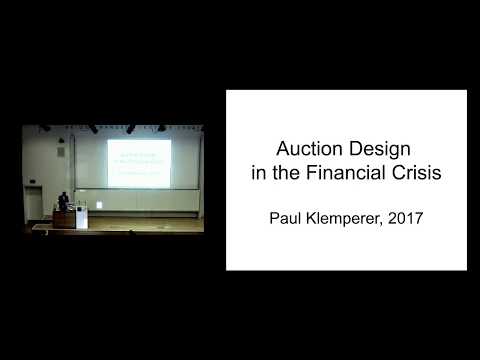
Paul Klemperer — Rare Footage & Clips
Paul Klemperer's contributions to economics have left an indelible mark on the field, but what may come as a surprise is that his expertise extends far beyond the realm of finance and investing. As the Edgeworth Professor of Economics at Oxford University, Klemperer has dedicated his career to understanding the intricacies of industrial economics, competition policy, auction theory, and climate change economics and policy.
In our archive, we have an exclusive collection of expert interviews with Klemperer that offer a glimpse into his remarkable journey. One such clip, "The Economics of Auctions," showcases his in-depth knowledge on the subject (Clip #KLEMPERER-01). In this enlightening discussion, Klemperer explains how auction theory can be applied to various industries, including art and collectibles. His insights are particularly relevant for investors seeking to understand the intricacies of market dynamics.
Klemperer's academic background is a testament to his intellectual curiosity and dedication to his craft. Born on August 15, 1956, in the Midlands, he attended King Edward's School in Birmingham before pursuing an engineering degree from Cambridge University. This unique combination of disciplines has undoubtedly influenced his approach to economics, allowing him to tackle complex problems from multiple angles.
At Stanford University, Klemperer earned both an MBA and a PhD in economics, further solidifying his expertise in the field. His academic achievements are a testament to his exceptional intellectual abilities, which have been recognized by numerous prestigious institutions. In 1994, he was elected as a fellow of the Econometric Society, while in 1999, he became a fellow of the British Academy.
Klemperer's tenure at Oxford University has been marked by significant contributions to the field of economics. As Edgeworth Professor of Economics, he has succeeded Nobel Prize winner James Mirrlees, a feat that speaks volumes about his own academic prowess. His research has focused on various areas, including industrial economics and competition policy, which have far-reaching implications for businesses and policymakers alike.
One of Klemperer's most notable achievements is his membership in the UK Competition Commission from 2001 to 2005. During this period, he brought his expertise to bear on complex issues related to market competition, helping shape policies that promote fair trade practices. His involvement with the commission highlights the practical applications of his research and its impact on real-world problems.
Klemperer's election as a foreign honorary member of the American Academy of Arts and Sciences in 2005 is a testament to his international recognition within the academic community. This honor underscores his contributions to the field, which have transcended national boundaries and resonated with scholars from around the world.
In our archive, we also have an insightful clip titled "Climate Change Economics" (Clip #KLEMPERER-03), where Klemperer shares his expertise on the economic implications of climate change. His analysis is particularly relevant for investors seeking to understand the long-term consequences of environmental policies and their impact on various industries.
While Klemperer's work has had a profound impact on economics, it is worth noting that there is no direct connection between his research and music history. However, one could argue that his expertise in auction theory has implications for art market dynamics, which may be relevant to collectors and investors interested in the world of fine art.
In conclusion, Paul Klemperer's remarkable career as an economist has left a lasting legacy in the field. His contributions to industrial economics, competition policy, auction theory, and climate change economics and policy have far-reaching implications for businesses, policymakers, and investors alike. Through our exclusive archive, we offer a unique glimpse into his expertise, providing valuable insights for those seeking to navigate the complexities of finance and investing.
Curated from public records and music databases.