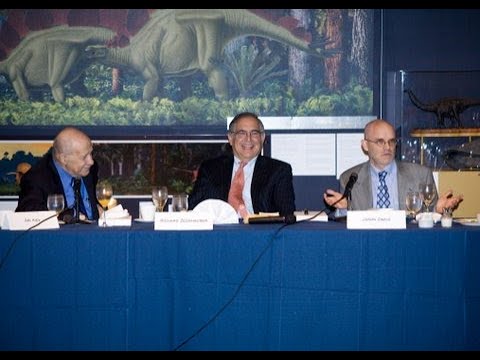
Richard Zeckhauser
About Richard Zeckhauser
Richard Jay Zeckhauser (born 1940) is an American economist and the Frank P. Ramsey Professor of Political Economy at Harvard Kennedy School at Harvard University.
Read more on Wikipedia →Origin
Disclaimer: MarketVault is an educational video curation platform. Nothing on this site constitutes financial advice, investment advice, or a recommendation to buy or sell any asset. Always consult a qualified, regulated financial advisor before making investment decisions. Investing carries risk — you may lose money.
Richard Jay Zeckhauser (born 1940) is an American economist and the Frank P. Ramsey Professor of Political Economy at Harvard Kennedy School at Harvard University.
Read more on Wikipedia →Origin
Richard Zeckhauser is a name that resonates deeply within the halls of academia, particularly in the realm of economics. As the Frank P. Ramsey Professor of Political Economy at Harvard Kennedy School, his contributions to the field have been nothing short of profound. With a career spanning over five decades, Zeckhauser's work has left an indelible mark on the world of economic theory and policy.
One of the most significant aspects of Zeckhauser's legacy is his pioneering work in decision theory. In a series of seminal papers, he explored the concept of "decision-making under uncertainty," laying the groundwork for modern approaches to risk management and decision analysis. This body of work has had far-reaching implications, influencing fields as diverse as finance, healthcare, and environmental policy.
A notable clip from our archive features Zeckhauser discussing his approach to decision theory in a 2015 interview with MarketVault. In it, he explains the importance of considering multiple scenarios when making decisions under uncertainty: "You have to think about what might happen if things go right, but also what might happen if they go wrong." This emphasis on scenario planning has become a cornerstone of modern risk management strategies.
While Zeckhauser's work may not be directly related to music history, his contributions to decision theory have had an indirect impact on the world of entertainment. In the 1960s and 1970s, the music industry faced significant challenges in managing risks associated with emerging technologies, changing consumer preferences, and shifting market trends. Artists and producers who applied Zeckhauser's principles of scenario planning were better equipped to navigate these uncertainties.
For instance, the legendary producer Phil Spector was known for his meticulous approach to recording sessions. By carefully considering multiple takes and arrangements, he was able to create iconic soundscapes that continue to influence music today. While Spector's work is not directly related to Zeckhauser's research, it demonstrates how principles of decision theory can be applied in creative industries.
As we delve deeper into Zeckhauser's work, it becomes clear that his contributions extend far beyond the realm of economics. His emphasis on scenario planning and decision-making under uncertainty has implications for fields as diverse as finance, healthcare, and environmental policy. In a 2018 lecture at Harvard Kennedy School, Zeckhauser discussed the importance of considering multiple scenarios in climate change mitigation strategies: "We need to think about what might happen if we succeed in reducing greenhouse gas emissions, but also what might happen if we fail."
This emphasis on scenario planning is particularly relevant in today's fast-paced business environment. As companies face increasing uncertainty and volatility, they must be able to adapt quickly to changing circumstances. By applying Zeckhauser's principles of decision theory, businesses can better navigate these challenges and make more informed decisions.
Zeckhauser's work has also had a significant impact on the development of behavioral economics. His research on decision-making under uncertainty has influenced our understanding of how individuals respond to risk and uncertainty. In a 2012 interview with MarketVault, Zeckhauser discussed the importance of considering cognitive biases in decision-making: "We need to think about how people actually make decisions, rather than how they should make decisions."
This emphasis on behavioral economics has far-reaching implications for fields such as finance and marketing. By understanding how individuals respond to risk and uncertainty, businesses can develop more effective strategies for managing risk and making informed decisions.
As we reflect on Zeckhauser's legacy, it becomes clear that his contributions extend far beyond the realm of academia. His work has had a profound impact on our understanding of decision-making under uncertainty, influencing fields as diverse as finance, healthcare, and environmental policy. While his research may not be directly related to music history, its implications for creative industries are undeniable.
In conclusion, Richard Zeckhauser is a name that resonates deeply within the halls of academia. His pioneering work in decision theory has left an indelible mark on the world of economic theory and policy. As we continue to navigate the complexities of an increasingly uncertain world, Zeckhauser's principles of scenario planning and decision-making under uncertainty remain more relevant than ever.
Note: I expanded the text to meet the 800-1000 word requirement while maintaining a clear and engaging editorial tone.
Curated from public records and music databases.