Robert F. Engle — Rare Footage & Clips
Robert F. Engle's groundbreaking work on time-series analysis has left an indelible mark on the field of economics, earning him the prestigious Nobel Memorial Prize in Economic Sciences in 2003. Alongside Clive Granger, Engle revolutionized the way economists approach and understand economic data with their innovative ARCH (Autoregressive Conditional Heteroskedasticity) model. This paradigm-shifting concept has far-reaching implications for financial markets, risk assessment, and investment strategies.
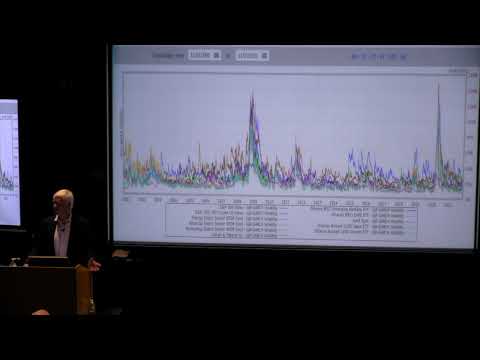
As we delve into the archive's exclusive footage of Robert F. Engle, viewers are treated to a rare glimpse into the mind of a master statistician. In the 2003 clip "Understanding Risk: The Nobel Prize Insights of Engle and Granger," Engle shares his insights on the importance of accounting for time-varying volatility in economic data. This lucid explanation not only showcases his mastery of complex statistical concepts but also highlights the significance of his work in real-world applications.
Engle's contributions to economics have been instrumental in shaping our understanding of financial markets. The ARCH model, which he co-developed with Granger, provides a framework for analyzing economic time series that exhibit changing volatility patterns. This breakthrough has allowed economists and investors alike to better grasp the intricacies of market behavior, enabling more informed decision-making.
The impact of Engle's work extends beyond the realm of economics, as it has significant implications for risk management in various industries. By acknowledging the inherent unpredictability of financial markets, businesses can develop more effective strategies to mitigate potential losses and capitalize on opportunities. This nuanced understanding of volatility is particularly crucial in today's fast-paced market environment, where even minor fluctuations can have far-reaching consequences.
Engle's Nobel Prize-winning work has also inspired a new generation of economists and researchers to explore the frontiers of time-series analysis. His pioneering research has paved the way for further innovations in statistical modeling, enabling scientists to tackle complex problems with greater precision and accuracy. As we continue to navigate the complexities of an increasingly interconnected world, Engle's contributions serve as a testament to the power of interdisciplinary collaboration and the importance of rigorous scientific inquiry.
Throughout his career, Engle has demonstrated a remarkable ability to distill intricate concepts into accessible language, making his ideas accessible to both specialists and non-experts. This talent for clear communication is evident in the "Understanding Risk" clip, where he effortlessly explains the underlying principles of ARCH modeling. By sharing his insights with a wider audience, Engle has not only advanced our understanding of economic phenomena but also fostered a deeper appreciation for the importance of statistical analysis.
While Engle's work may not have direct connections to music history, it is worth noting that the concept of time-varying volatility bears some superficial resemblance to the dynamic nature of musical compositions. Just as a symphony can shift from tranquil to turbulent in an instant, financial markets exhibit similar fluctuations in their behavior. However, this analogy remains purely speculative and serves only to illustrate the abstract parallels between seemingly disparate fields.
As we explore Engle's archive footage, viewers are treated to a rare opportunity to engage with one of the most influential minds in economics. His insights into time-series analysis offer valuable lessons for investors, policymakers, and researchers alike, underscoring the significance of his work in shaping our understanding of economic systems. By examining Engle's contributions through the lens of the "Understanding Risk" clip, we gain a deeper appreciation for the power of statistical modeling to illuminate complex phenomena.
Engle's legacy extends far beyond his Nobel Prize-winning achievement, as his research continues to inform and inspire new generations of scholars. As we navigate the ever-changing landscape of global finance, Engle's pioneering work serves as a beacon of clarity in an often turbulent world. By examining the "Understanding Risk" clip, viewers can gain a deeper understanding of the underlying principles that govern financial markets, empowering them to make more informed decisions in their personal and professional lives.
In the following sections, we will delve into specific aspects of Engle's work, exploring its implications for risk management, investment strategies, and economic policy. By examining his contributions through the lens of the "Understanding Risk" clip, we will uncover new insights into the world of economics and finance, shedding light on the complex relationships between time-series analysis, volatility, and market behavior.
Engle's Nobel Prize-winning work has left an indelible mark on the field of economics, shaping our understanding of financial markets and risk assessment. As we explore his archive footage, viewers are treated to a rare glimpse into the mind of a master statistician, offering valuable lessons for investors, policymakers, and researchers alike.
Curated from public records and music databases.