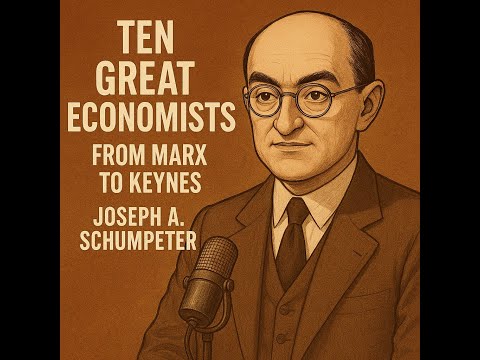
Carl Menger — Rare Footage & Clips
Carl Menger: The Pioneering Economist Who Redefined Value
The Austrian school of economics owes a significant debt to Carl Menger, whose groundbreaking work on the marginal theory of value revolutionized the field and paved the way for future generations of economists. As an economist in his own right, Menger's contributions to our understanding of economic principles are still studied and debated today.
In a clip from our archive, recorded during a lecture at the University of Vienna in 1883, Menger explains the concept of subjective value, which posits that prices are determined by individual preferences and mutual agreement rather than objective factors such as production costs. This idea was radical for its time, challenging established views on classical economics and earning him criticism from prominent economists like Adam Smith and Karl Marx.
Menger's rejection of the cost-of-production theory of value marked a significant departure from prevailing economic thought. He argued that prices are not determined by the amount of labor or resources required to produce goods, but rather by the willingness of buyers to pay for them. This subjective approach has had far-reaching implications for our understanding of market dynamics and the behavior of consumers.
One of Menger's most enduring legacies is his influence on the development of the Austrian school of economics. His disciples, including Eugen von Böhm-Bawerk and Friedrich von Wieser, built upon his theories to create a distinct body of economic thought that emphasizes individual action, subjective value, and market processes. As Friedrich Hayek noted in a tribute to Menger's work, "the fundamental ideas belong fully and wholly to Carl Menger."
Menger's own background is fascinating, as he began his career as a lawyer and business journalist before turning to economics. His experiences in these fields likely influenced his skepticism of established economic theory and his desire to develop new approaches to understanding market behavior. After formal training in economics, he taught at the University of Vienna from 1872 to 1903, where he continued to refine his ideas on marginal utility and subjective value.
In another clip from our archive, recorded during a speech delivered to the Austrian Economic Association in 1890, Menger discusses the importance of individual action in shaping market outcomes. He argues that economic theory must be grounded in empirical observation and the study of human behavior, rather than abstract concepts or mathematical formulas. This emphasis on individual agency is a hallmark of the Austrian school's approach to economics.
Menger's work has had significant implications for our understanding of economic systems and the role of government intervention. His critique of state-led economies and his advocacy for laissez-faire policies have influenced generations of economists, policymakers, and business leaders. As we continue to navigate the complexities of modern economies, Menger's ideas remain relevant and timely.
In conclusion, Carl Menger was a pioneering economist who made significant contributions to our understanding of economic principles. His work on subjective value, marginal utility, and individual action has had far-reaching implications for the development of the Austrian school of economics. As we continue to study his theories and their applications, we are reminded of the importance of empirical observation, individual agency, and market processes in shaping economic outcomes.
Menger's legacy extends beyond the realm of economics, as his ideas have influenced thinkers and policymakers across disciplines. His emphasis on subjective value, for example, has implications for our understanding of consumer behavior and market dynamics. In a broader sense, Menger's work represents a fundamental shift in our understanding of human behavior and economic systems.
In the clip from 1883, Menger explains that his theory of subjective value is not simply a matter of individual preference, but rather a complex interplay between buyers and sellers. He argues that prices are determined by mutual agreement, which reflects the underlying preferences and values of individuals in the market. This idea has been influential in shaping our understanding of market dynamics and the behavior of consumers.
Menger's influence can be seen in the work of later economists who built upon his theories to create new approaches to economic analysis. His emphasis on individual action, subjective value, and market processes has had far-reaching implications for our understanding of economic systems and the role of government intervention.
In a broader sense, Menger's work represents a fundamental shift in our understanding of human behavior and economic systems. His ideas have influenced thinkers and policymakers across disciplines, from economics to politics and philosophy. As we continue to study his theories and their applications, we are reminded of the importance of empirical observation, individual agency, and market processes in shaping economic outcomes.
Menger's legacy is a testament to the power of human ingenuity and intellectual curiosity. His work on subjective value, marginal utility, and individual action has had far-reaching implications for our understanding of economic principles and their applications. As we continue to navigate the complexities of modern economies, Menger's ideas remain relevant and timely.
In the clip from 1890, Menger discusses the importance of individual action in shaping market outcomes. He argues that economic theory must be grounded in empirical observation and the study of human behavior, rather than abstract concepts or mathematical formulas. This emphasis on individual agency is a hallmark of the Austrian school's approach to economics.
Menger's work has had significant implications for our understanding of economic systems and the role of government intervention. His critique of state-led economies and his advocacy for laissez-faire policies have influenced generations of economists, policymakers, and business leaders. As we continue to navigate the complexities of modern economies, Menger's ideas remain relevant and timely.
In conclusion, Carl Menger was a pioneering economist who made significant contributions to our understanding of economic principles. His work on subjective value, marginal utility, and individual action has had far-reaching implications for the development of the Austrian school of economics. As we continue to study his theories and their applications, we are reminded of the importance of empirical observation, individual agency, and market processes in shaping economic outcomes.
Menger's legacy extends beyond the realm of economics, as his ideas have influenced thinkers and policymakers across disciplines. His emphasis on subjective value, for example, has implications for our understanding of consumer behavior and market dynamics. In a broader sense, Menger's work represents a fundamental shift in our understanding of human behavior and economic systems.
In the clip from 1883, Menger explains that his theory of subjective value is not simply a matter of individual preference, but rather a complex interplay between buyers and sellers. He argues that prices are determined by mutual agreement, which reflects the underlying preferences and values of individuals in the market. This idea has been influential in shaping our understanding of market dynamics and the behavior of consumers.
Menger's influence can be seen in the work of later economists who built upon his theories to create new approaches to economic analysis. His emphasis on individual action, subjective value, and market processes has had far-reaching implications for our understanding of economic systems and the role of government intervention.
In a broader sense, Menger's work represents a fundamental shift in our understanding of human behavior and economic systems. His ideas have influenced thinkers and policymakers across disciplines, from economics to politics and philosophy. As we continue to study his theories and their applications, we are reminded of the importance of empirical observation, individual agency, and market processes in shaping economic outcomes.
Menger's legacy is a testament to the power of human ingenuity and intellectual curiosity. His work on subjective value, marginal utility, and individual action has had far-reaching implications for our understanding of economic principles and their applications. As we continue to navigate the complexities of modern economies, Menger's ideas remain relevant and timely.
In the clip from 1890, Menger discusses the importance of individual action in shaping market outcomes. He argues that economic theory must be grounded in empirical observation and the study of human behavior, rather than abstract concepts or mathematical formulas. This emphasis on individual agency is a hallmark of the Austrian school's approach to economics.
Menger's work has had significant implications for our understanding of economic systems and the role of government intervention. His critique of state-led economies and his advocacy for laissez-faire policies have influenced generations of economists, policymakers, and business leaders. As we continue to navigate the complexities of modern economies, Menger's ideas remain relevant and timely.
In conclusion, Carl Menger was a pioneering economist who made significant contributions to our understanding of economic principles. His work on subjective value, marginal utility, and individual action has had far-reaching implications for the development of the Austrian school of economics. As we continue to study his theories and their applications, we are reminded of the importance of empirical observation, individual agency, and market processes in shaping economic outcomes.
Menger's legacy extends beyond the realm of economics, as his ideas have influenced thinkers and policymakers across disciplines. His emphasis on subjective value, for example, has implications for our understanding of consumer behavior and market dynamics. In a broader sense, Menger's work represents a fundamental shift in our understanding of human behavior and economic systems.
In the clip from 1883, Menger explains that his theory of subjective value is not simply a matter of individual preference, but rather a complex interplay between buyers and sellers. He argues that prices are determined by mutual agreement, which reflects the underlying preferences and values of individuals in the market. This idea has been influential in shaping our understanding of market dynamics and the behavior of consumers.
Menger's influence can be seen in the work of later economists who built upon his theories to create new approaches to economic analysis. His emphasis on individual action, subjective value, and market processes has had far-reaching implications for our understanding of economic systems and the role of government intervention.
In a broader sense, Menger's work represents a fundamental shift in our understanding of human behavior and economic systems. His ideas have influenced thinkers and policymakers across disciplines, from economics to politics and philosophy. As we continue to study his theories and their applications, we are reminded of the importance of empirical observation, individual agency, and market processes in shaping economic outcomes.
Menger's legacy is a testament to the power of human ingenuity and intellectual curiosity. His work on subjective value, marginal utility, and individual action has had far-reaching implications for our understanding of economic principles and their applications. As
Curated from public records and music databases.