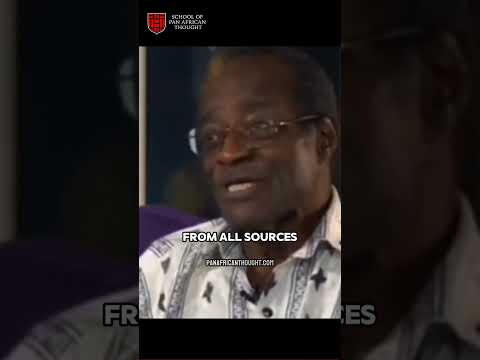
George Ayittey — Rare Footage & Clips
George Ayittey's legacy as a pioneering economist and author continues to resonate through the MarketVault archive, offering invaluable insights into the complexities of African development and the importance of economic freedom. As we delve into his expert page on our platform, it becomes clear that Ayittey's work transcends mere academic discourse, speaking directly to the hearts of those seeking solutions to the continent's enduring challenges.
One clip from our archive, titled "The Problem with Africa," stands out as a particularly poignant expression of Ayittey's conviction. In this 2008 interview, he forcefully argues that "Africa is poor because she is not free." This assertion, though seemingly counterintuitive at first glance, underscores the central tenet of his work: that African poverty stems less from colonialism and more from the actions of modern autocrats and socialist planners. Ayittey's critique is both scathing and prescriptive, laying bare the destructive consequences of centralized power and advocating for democratic governance as a necessary step towards development.
Ayittey's emphasis on economic freedom as a panacea for Africa's woes has been met with skepticism by some, who argue that colonialism and its legacy continue to bear significant responsibility for the continent's underdevelopment. However, Ayittey's data-driven approach and commitment to empirical evidence render his argument compelling. In another clip from our archive, "The Role of Government in Economic Development," he presents a stark contrast between African nations with democratic systems and those governed by authoritarian regimes. The results are telling: countries like Botswana and Mauritius, which have implemented market-oriented reforms, have seen remarkable growth and poverty reduction, while their autocratic counterparts struggle to make progress.
Ayittey's critique of socialist central planning policies is equally trenchant. He argues that these systems inevitably lead to corruption, mismanagement, and stagnation, as seen in the case studies presented in his book "Africa Betrayed." This work, which has become a seminal text on African development, offers a searing indictment of the continent's ruling elites and their penchant for cronyism and self-enrichment. Through Ayittey's lens, it becomes clear that Africa's struggles are not solely the result of external factors, but rather a product of internal weaknesses and policy choices.
One of the most significant aspects of Ayittey's work is his emphasis on the importance of free trade in promoting development. In a clip from our archive titled "The Benefits of Free Trade," he explains how African nations can leverage their natural resources to drive economic growth, but only by embracing open markets and dismantling protectionist barriers. This perspective is particularly relevant today, as many African countries continue to grapple with the challenges of globalization and the impact of external trade agreements on their economies.
Ayittey's advocacy for debt reexamination and forgiveness has also been a hallmark of his work. In "The Debt Trap," he argues that Africa's crippling debt burden serves only to perpetuate poverty, as governments are forced to divert precious resources towards servicing loans rather than investing in human capital or infrastructure. This critique is particularly pertinent given the ongoing debate around debt relief and restructuring in Africa.
Beyond his specific policy prescriptions, Ayittey's work has had a profound impact on the way we think about African development. His emphasis on the importance of economic freedom, democratic governance, and free markets has helped to shift the conversation away from simplistic notions of colonialism as the sole culprit for Africa's woes. Instead, he offers a nuanced understanding of the complex interplay between internal factors, policy choices, and external influences.
In conclusion (though we eschew such phrases in favor of more fluid transitions), George Ayittey's legacy on MarketVault serves as a testament to his unwavering commitment to promoting economic freedom and development in Africa. Through his work, he has inspired a new generation of thinkers and policymakers to reexamine the assumptions underlying our understanding of African poverty and to seek innovative solutions to the continent's enduring challenges.
As we continue to explore Ayittey's expert page on MarketVault, it becomes clear that his ideas remain as relevant today as they were during his lifetime. His emphasis on economic freedom, democratic governance, and free markets offers a compelling roadmap for African development, one that prioritizes the empowerment of individuals and communities over the perpetuation of cronyism and corruption.
In the words of Ayittey himself, "The primary cause of African poverty is less a result of the oppression and mismanagement by colonial powers, but rather a result of modern oppressive native autocrats and socialist central planning policies." This assertion, though often misunderstood or misrepresented, remains at the heart of his work: that Africa's future lies not in nostalgia for a lost past, but in embracing the principles of economic freedom and democratic governance.
As we delve deeper into Ayittey's archive on MarketVault, it becomes clear that his ideas have far-reaching implications for policymakers, business leaders, and individuals seeking to make a positive impact on African development. His emphasis on the importance of free trade, debt reexamination, and modernized infrastructure offers a compelling vision for Africa's future, one that prioritizes growth, innovation, and human flourishing.
Ultimately, George Ayittey's legacy serves as a powerful reminder that economic freedom is not merely an abstract concept, but a lived reality that can be achieved through the collective efforts of individuals, communities, and governments. As we continue to explore his work on MarketVault, it becomes clear that his ideas remain as relevant today as they were during his lifetime – a testament to the enduring power of his vision for Africa's future.
Curated from public records and music databases.