MarketVault
BrowseExpertsTopicsTimelineMapSubmit

MarketVault

Curated financial insights from the world's top experts. Invest in your knowledge.

BrowseExpertsTopicsDecadesSubmit a ClipAboutContact

© 2026 MarketVault. All footage remains the property of its original creators.

Privacy PolicyTerms of UseSupport

Developed with love as a personal project by Jamie McDonnell

ui-ux-design.comai-consultancy.company
Federico Sturzenegger - Presentación del Informe de Estabilidad Financiera - Primer — MarketVault
PreviousUse arrow keysNext
0 views
Share this clip

Federico Sturzenegger - Presentación del Informe de Estabilidad Financiera - Primer

Federico Sturzenegger
2010s2019youtube

### Informe de Estabilidad Financiera del Banco Central: Análisis y Medidas * Naturaleza del Informe: * Publicación semestral que analiza la situación estructural del sector financiero, no coyuntural. * Enfocado en la solvencia, liquidez y solidez del sistema financiero en su conjunto. * Estado Actual del Sistema Financiero Argentino: * Solidez y Estabilidad: Muy sólido y estable, con altos niveles de liquidez y solvencia. * Morosidad: Bajos ratios de morosidad, tanto históricamente como en comparación internacional. * Regulación: Adherencia estricta a los preceptos de Basilea, incluso implementando estándares futuros (2019) de forma anticipada. * Simulaciones de Estrés: El sistema financiero muestra una gran solvencia incluso bajo los supuestos más duros. * Capitalización: Niveles de capitalización muy altos, especialmente en el ratio de capital básico sobre activos totales. * Liquidez: Niveles de liquidez actuales son altos. * Rentabilidad: Margen financiero relativamente estable en los últimos años (2016 similar a 2015, menor que 2014). * Tasas de Interés: Aumento en las tasas cobradas por créditos y pagadas por depósitos, manteniendo el *spread* bancario constante. Se busca incentivar el ahorro pagando más al depositante. * Rentabilidad Real: La rentabilidad real del sector financiero es relativamente baja en comparación internacional. * Desafíos y Necesidad de Desarrollo: * Tamaño Reducido: El sistema financiero argentino es relativamente pequeño en comparación internacional. * Bajos Depósitos: Los depósitos representan solo el 15% del PIB, uno de los más bajos de la región, a pesar de que los argentinos tienen un ahorro significativo (40% del PIB en activos externos netos). * Falta de Confianza Histórica: Históricamente, el ahorro en el sistema financiero ha perdido valor real (ej: 100 pesos en 1981 valdrían 1.5 centavos hoy). * Corto Plazo de Pasivos: Casi el 80% de los pasivos son a menos de un mes, lo que dificulta la intermediación de crédito a largo plazo. * Baja Disponibilidad de Crédito: Consecuencia directa de la falta de depósitos, el crédito es escaso en Argentina. * Crédito Hipotecario: Ha mostrado una caída sostenida. * Iniciativas para el Desarrollo del Sector Financiero: * Pilar Fundamental: Inflación baja y estable para permitir contratos a largo plazo. * Incentivo al Ahorro: * UVIs (Unidades de Valor Adquisitivo): Depósitos y créditos ajustados por inflación, ofreciendo una tasa de interés real positiva y estable. * Ejemplo de crédito hipotecario en UVIs: vivienda de $391.000 con cuota inicial de $3.157 y requisito de ingreso de $10.523. * Crecimiento de UVIs: depósitos multiplicados por 8, créditos por 3 en el último mes. * Profundización del Sistema Financiero: * Liberación de Tasas de Interés: Permite a los bancos pagar más a los depositantes, atrayendo ahorros (depósitos + Lebacs de privados subieron 60-70% en 6 meses). * Promoción de la Competencia: * Simplificación de trámites para la expansión de sucursales (no más autorizaciones, reducción de burocracia). * Reducción de requisitos edilicios para sucursales en el interior del país (menor costo, mayor bancarización). * Habilitación de nuevos canales de pago (Plataforma de Pagos Móviles). * Transparencia: * Obligación de difundir el Costo Financiero Total (CFT) de forma destacada. * Bancos deben mostrar tarifas de la competencia al cliente al cobrar comisiones. * Flexibilidad para el uso de resúmenes electrónicos. * Reducción de Costos Operativos: * Emisión del billete de $500 (agiliza, reduce transporte y espacio, aumenta productividad de cajeros). * Recarga de Cajeros: Permite a negocios locales (ej. supermercados) recargar ATMs, reduciendo costos de transporte de valores, especialmente en el interior. * Regulación de transportadores de valores: Eliminación de requisitos innecesarios. * Apertura de Tesoros: Bancos pueden abrir tesoros los fines de semana para recargar cajeros, mejorando la disponibilidad de efectivo. * Eliminación de la obligación de cierre de cuentas inactivas: Reduce costos administrativos y facilita el acceso a servicios bancarios.


Know someone who'd love this clip?

Share it with friends and fellow fans.
Share this clip

Keep Exploring

2000s2020sAll ExpertsAll TopicsAll Decades

About Federico Sturzenegger

Federico Sturzenegger (born 11 February 1966) is an Argentine economist who is the current head of the Ministry of Deregulation and State Transformation under Javier Milei's presidency. He previously served as President of the Central Bank between 2015 and 2018. He was a professor of economics at University of California, Los Angeles, Torcuato di Tella University (where he also was Dean of the Business School), and Kennedy School of Government of Harvard University. Currently he teaches at Unive...

More about Federico Sturzenegger→

Added 2 Apr 2026

Browse by Format
More from 2010s

More from the 2010s

View all →
Thumbnail for 2015 PRC Symposium: Keynote Address: Financial Market Reforms and the Future of Pensions by Franklin Allen33:18

2015 PRC Symposium: Keynote Address: Financial Market Reforms and the Future of Pensions

Franklin Allen

2010s
Thumbnail for Franklin Allen by Franklin Allen37:15

Franklin Allen

Franklin Allen

2010sTool ReviewExpert Interview
Thumbnail for Nobel Symposium John Geanakoplos Leverage and cycles by John Geanakoplos28:52

Nobel Symposium John Geanakoplos Leverage and cycles

John Geanakoplos

2010s
Thumbnail for Kenneth Rogoff Drops a Bomb: China's Currency Isn't Cheap—It's Dangerously Expensive by Kenneth Rogoff11:38

Kenneth Rogoff Drops a Bomb: China's Currency Isn't Cheap—It's Dangerously Expensive

Kenneth Rogoff

2010sCrash Analysis

About This Footage

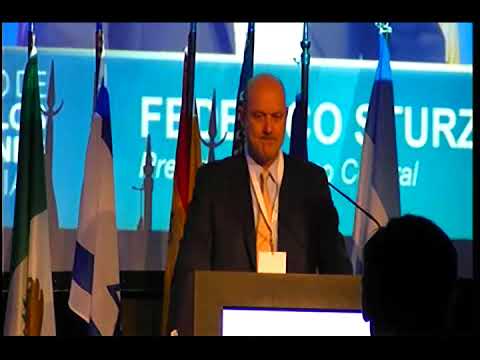
This clip of Federico Sturzenegger's presentation on the Financial Stability Report is a significant piece of footage for anyone interested in understanding the financial landscape of Argentina in 2019. As the then-President of the Central Bank, Sturzenegger provides an in-depth analysis of the country's financial situation, highlighting both its strengths and weaknesses.

The report itself is notable for its focus on structural issues rather than short-term fluctuations. By examining the solvency, liquidity, and solidity of the entire financial system, the authors aim to provide a comprehensive understanding of Argentina's economic health. This approach is particularly relevant in 2019, as the country was still grappling with the aftermath of the 2001 crisis.

One of the most striking aspects of Sturzenegger's presentation is his assessment of the Argentine financial system's stability and solvency. He reports that the system is "very solid and stable," with high levels of liquidity and solvency. This is a marked improvement from previous years, and Sturzenegger attributes this progress to the Central Bank's adherence to strict regulatory standards, including those outlined in the Basilea Accords.

The report also highlights the country's low rates of morosidad (non-payment) and its high levels of capitalization. This suggests that Argentine banks are well-capitalized and able to withstand economic shocks. Furthermore, Sturzenegger notes that the system has shown a high degree of resilience in stress tests, even under the most extreme scenarios.

While the presentation is largely positive, it also touches on some areas of concern. For instance, Sturzenegger notes that interest rates have increased in recent years, which may impact borrowing costs for consumers and businesses. However, he argues that this increase has helped to maintain a stable spread between lending and deposit rates.

The significance of this footage lies not only in its content but also in the expertise of the presenter. Federico Sturzenegger is an accomplished economist with a deep understanding of Argentina's financial system. His insights are informed by his experience as President of the Central Bank, where he played a key role in shaping the country's monetary policy.

In conclusion, this clip provides a unique window into Argentina's financial landscape in 2019. Sturzenegger's presentation offers valuable insights for anyone interested in understanding the country's economic strengths and weaknesses. As an expert in his field, Sturzenegger brings a level of authority and credibility to the discussion, making this footage a must-watch for anyone seeking to understand the complexities of Argentina's financial system.

Editorial context researched and compiled from verified sources.

More from Federico Sturzenegger

View all →
Thumbnail for FEDERICO STURZENEGGER, 9º CONGRESO DE DESARROLLOS E INVERSIONES INMOBILIARIAS, EXPO REAL ESTATE 2017 by Federico Sturzenegger5:52

FEDERICO STURZENEGGER, 9º CONGRESO DE DESARROLLOS E INVERSIONES INMOBILIARIAS, EXPO REAL ESTATE 2017

Federico Sturzenegger

2010s
Thumbnail for Sturzenegger en Argentina Investment Conference 2017 - AS/COA by Federico Sturzenegger47:20

Sturzenegger en Argentina Investment Conference 2017 - AS/COA

Federico Sturzenegger

2010s
Thumbnail for Promo Invertir en Dolares con Federico Sturzenegger #trading #elclubdeinversion #americanpolitician by Federico Sturzenegger0:59

Promo Invertir en Dolares con Federico Sturzenegger #trading #elclubdeinversion #americanpolitician

Federico Sturzenegger

Thumbnail for Promo 2 Invertir en Dólares con Federico Sturzenegger by Federico Sturzenegger0:53

Promo 2 Invertir en Dólares con Federico Sturzenegger

Federico Sturzenegger

Argentina