0 views
Share this clip
Would a “Wealth Tax” Help Combat Inequality? A Debate with Saez, Summers, and Mankiw
Know someone who'd love this clip?
Share it with friends and fellow fans.
Share this clip
Disclaimer: MarketVault is an educational video curation platform. Nothing on this site constitutes financial advice, investment advice, or a recommendation to buy or sell any asset. Always consult a qualified, regulated financial advisor before making investment decisions. Investing carries risk — you may lose money.
Know someone who'd love this clip?
Share it with friends and fellow fans.
(Full session) Emmanuel Saez, a leading architect of the “wealth tax” plans advocated by Senators Elizabeth Warren and Bernie Sanders, outlined his proposals at the PIIE conference on “Combating Inequality: Rethinking Policies to Reduce Inequality in Advanced Economies” on October 17–18, 2019. Lawrence Summers of Harvard, top economic policymaker in the Clinton and Obama administrations, delivered a tough critique of Professor Saez’s proposals. He was joined in the criticism by Gregory Mankiw, also a Harvard economic professor, and a former top economic adviser to President George W. Bush. Watch this important and timely discussion, moderated by Catherine Rampell of the Washington Post. For more details on the event, visit https://www.piie.com/events/combating-inequality-rethinking-policies-reduce-inequality-advanced-economies.
Emmanuel Saez is a French economist who is a professor of economics at the University of California, Berkeley. His work specializes in optimal tax theory and inequality including tracking the incomes of the poor, middle class and rich around the world. Together with economists Thomas Piketty and Gabriel Zucman, their work shows that top earners in the United States have taken an increasingly larger share of overall income over the last three decades, with almost as much inequality as before the...
More about Emmanuel Saez→Added
The 2019 debate between Emmanuel Saez and his critics, Lawrence Summers and Gregory Mankiw, is a notable and interesting footage that sheds light on the contentious issue of wealth inequality. This expert discussion, moderated by Catherine Rampell of the Washington Post, offers a unique insight into the complexities of optimal tax theory and its potential impact on reducing economic disparities.
Emmanuel Saez, a renowned French economist and professor at the University of California, Berkeley, is a leading proponent of the "wealth tax" concept. His proposals have been championed by prominent politicians such as Senators Elizabeth Warren and Bernie Sanders. However, his ideas have also faced intense scrutiny from experts like Summers and Mankiw, who delivered a scathing critique of Saez's plans during this debate.
The discussion is particularly noteworthy given the credentials of the participants involved. Lawrence Summers, a former top economic policymaker in the Clinton and Obama administrations, brought a wealth of experience to the table, while Gregory Mankiw, a Harvard economic professor and former adviser to President George W. Bush, added his expertise on tax policy. The exchange between these experts provides a nuanced understanding of the theoretical underpinnings of Saez's proposals and their potential practical implications.
One of the key aspects of this debate is its relevance to contemporary economic issues. The discussion revolves around the concept of wealth inequality, which has become a pressing concern in many advanced economies. Saez's "wealth tax" plan aims to address this issue by imposing a tax on net worth above a certain threshold. However, his critics argue that such a policy would be ineffective and potentially counterproductive.
The debate also highlights the importance of considering various perspectives when tackling complex economic problems. While Saez presents a compelling case for his proposals, Summers and Mankiw raise valid concerns about their feasibility and potential consequences. This exchange demonstrates the value of expert discussion in refining our understanding of economic theories and policies.
This footage is particularly valuable given its comprehensive nature. The debate spans over an hour and a half, allowing viewers to engage with the intricacies of optimal tax theory and its applications. The discussion covers various aspects of Saez's proposals, including their potential impact on economic growth, income distribution, and social welfare.
In conclusion, this 2019 debate between Emmanuel Saez and his critics is an essential resource for anyone interested in understanding the complexities of wealth inequality and optimal tax theory. The exchange between these experts offers a thought-provoking exploration of the theoretical underpinnings of Saez's proposals and their potential practical implications.
Curated from public records and music databases.
 2:07
2:07 0:22
0:22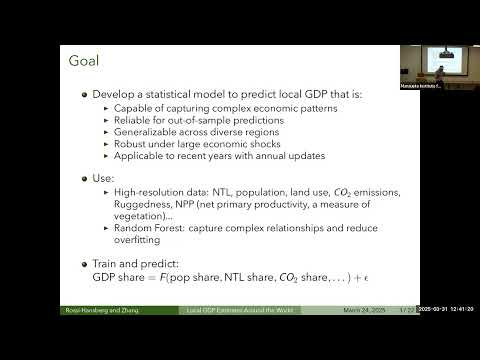 1:00:56
Esteban Rossi-Hansberg
 0:51
0:51