0 views
Share this clip
Know someone who'd love this clip?
Share it with friends and fellow fans.
Share this clip
Disclaimer: MarketVault is an educational video curation platform. Nothing on this site constitutes financial advice, investment advice, or a recommendation to buy or sell any asset. Always consult a qualified, regulated financial advisor before making investment decisions. Investing carries risk — you may lose money.
Know someone who'd love this clip?
Share it with friends and fellow fans.
This episode of Monetary Matters is brought to you by VanEck. Learn more about the VanEck Semiconductor ETF (SMH): http://vaneck.com/SMHJack Learn more about the VanEck Fabless Semiconductor ETF (SMHX): http://vaneck.com/SMHXJack Renowned trade historian Douglas Irwin joins Jack to compare the ongoing shifts in American trade policy to Smoot-Hawley tariff during the Great Depression and the McKinley-era tariffs of the late 19th century of which President Trump speaks so fondly. Irwin, the John French Professor of Economics at Dartmouth College, and author of “Clashing over Commerce” and “Trade Policy Disaster” among other titles, notes that most economic historians agree that the Smoot-Hawley tariff was not the primary cause of the Great Depression. Rather, while it probably exacerbated the global economic slowdown, trade barriers in a narrow sense served their respective countries' interest in limiting gold outflows. Professor Irwin argues that current tariffs (2% to ~15%) are a greater shock than Smoot-Hawley (38% to 42%), because of the higher rate of change and because U.S. trade as a percentage of GDP is higher now than it was in the 1930s. Jack lobs pro-protectionist arguments that Irwin strongly rejects. The two reflect on balance of payments, with Irwin noting that large capital inflows into the United States are a major cause of the large and persistent U.S. trade deficit. Recorded on August 7, 2025. Douglas Irwin’s books discussed: “Trade Policy Disaster: Lessons from the 1930s”: https://direct.mit.edu/books/monograph/3374/Trade-Policy-DisasterLessons-from-the-1930s “Clashing over Commerce: A History of US Trade Policy”: https://press.uchicago.edu/ucp/books/book/chicago/C/bo24475328.html “Peddling Protectionism: Smoot-Hawley and the Great Depression”: https://press.princeton.edu/books/paperback/9780691178066/peddling-protectionism?srsltid=AfmBOoqh-ZTEvY-wNf7wqitXQpkh-tfA7MEOyqxhKCoeHo7WbyUaJRB9 Douglas Irwin’s papers discussed: “TARIFF INCIDENCE: EVIDENCE FROM U.S. SUGAR DUTIES, 1890-1930”: https://www.nber.org/system/files/working_papers/w20635/w20635.pdf “HIGHER TARIFFS, LOWER REVENUES? ANALYZING THE FISCAL ASPECTS OF THE "GREAT TARIFF DEBATE OF 1888"”: https://www.nber.org/system/files/working_papers/w6239/w6239.pdf Follow Douglas Irwin on Twitter https://x.com/D_A_Irwin Follow Jack Farley on Twitter https://x.com/JackFarley96 Follow Monetary Matters on: Apple Podcast https://rb.gy/s5qfyh Spotify https://rb.gy/x56dx5 YouTube https://rb.gy/dpwxez Timestamps 00:00 Intro 00:29 VanEck $SMHX Pre-roll 01:10 The Scale of Trump Tariffs Is Larger Than Smoot-Hawley Tariff of 1930 02:49 Deflation Drastically Pushed Tariff Rates So High In 1930s 15:15 Why Most Economists Don't Like Tariffs 18:42 VanEck $SMHX Mid-roll 19:50 Do Tariffs Promote Domestic Industry? 35:49 Is U.S. Dollar Overvalued, On A Trade Basis? 42:11 Balance of Payments Equation 43:58 U.S. Now = Great Britain In 1930s? 47:04 Does U.S. As Deficit Country Have Stronger Negotiating Position? 48:53 Tariff Incidence: Who Pays Tariffs? 52:11 The Best Possible Scenario For Tariffs (No Retaliation, Exports Don't Go Down At All) 53:37 History of Tariffs In U.S. In 1800s 1:10:36 Do Other Countries Cheat At Trade? 1:15:32 VanEck $SMHX End-roll #tarrifs #stocks #stockmarket #semiconductor #macro #investing #economics #economy #hedgefunds #macroeconomics #trade #chinaeconomy #trumptariffs
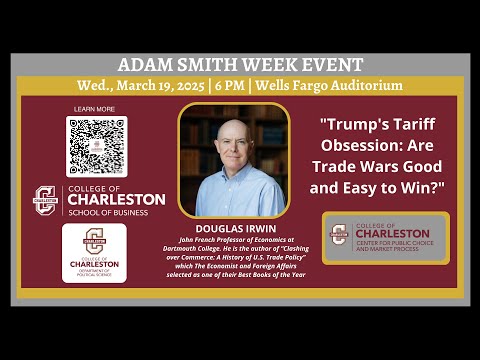
Douglas A. Irwin is the John French Professor of Economics in the Economics Department at Dartmouth College and the author of seven books. He is an expert on both past and present U.S. trade policy, especially policy during the Great Depression. He is frequently sought by media outlets such as The Economist and Wall Street Journal to provide comment and his opinion on current events. He also writes op-eds and articles about trade for mainstream media outlets like The Wall Street Journal, The New...
More about Douglas Irwin→Added
 1:06
1:06 0:47
0:47Financial analyst
 29:53
29:53 6:22
6:22Financial analyst
 5:12
5:12Douglas Irwin
 0:35
0:35Douglas Irwin
 1:06:26
Douglas Irwin
 2:29
2:29Douglas Irwin