0 views
Share this clip
Know someone who'd love this clip?
Share it with friends and fellow fans.
Share this clip
Disclaimer: MarketVault is an educational video curation platform. Nothing on this site constitutes financial advice, investment advice, or a recommendation to buy or sell any asset. Always consult a qualified, regulated financial advisor before making investment decisions. Investing carries risk — you may lose money.
Know someone who'd love this clip?
Share it with friends and fellow fans.
LECTURE 5 - MINSKY’s MODERN MONEY THEORY (MMT) AND FUNCTIONAL FINANCE (Institute of Economics, Campinas, Unicamp, August 14th, 2018) In the fifth section of the Modern Money Theory Course, Professor L. Randall Wray goes back and tracks the Minskyan routes of MMT and his connections with Abba Lerner’s principles of Functional Finance. Coming from this perspective, the main argument of MMT is that fiscal policy primary target might be full employment without high inflation. And also argues why a typical general aggregate demand stimulus does not generate full employment and leads to effects ranging from increasing financial fragility, inflation and inequality. Does government debt always pose a risk of default or hyperinflation? How does functional finance reconcile full employment with price stability, and what role do institutional realities play? This fifth and final lecture from the "An Introduction to Modern Money Theory" miniseries, delivered by Professor L. Randall Wray, delves into the principles of functional finance and integrates them with the insights of Hyman Minsky. The session clarifies the MMT framework for macroeconomic policy, addressing common critiques and historical misunderstandings. Professor Wray highlights the core tenets of functional finance, originally formulated by Abba Lerner: Policy Goals Over Budgetary Outcomes: Functional finance prioritizes real economic goals, primarily full employment and price stability, over achieving a balanced budget or minimizing national debt [04:06]. The government's budget position is merely a tool to achieve these ends, not an end in itself. No Default Risk on National Debt: A sovereign government, issuing debt in its own currency, faces no risk of default [08:33]. The only risks are potential changes in interest rates or price levels, which functional finance aims to manage. Minsky's Nuanced Approach: Wray emphasizes that Minsky, while initially aligned with Lerner, later developed a more nuanced approach. Minsky criticized "mechanical Keynesianism" [57:03] (general demand pumping without regard for what is spent), advocating for directed spending [13:42] and resource-creating government spending [50:06]. Minsky stressed the importance of institutional realities and warned that aggressive, untargeted stimulus could lead to financial instability. Stagflation and the Phillips Curve: The lecture addresses the phenomenon of stagflation (simultaneous high inflation and unemployment) [57:52], which challenged conventional Keynesianism. Functional finance, unlike the Phillips Curve, asserts that full employment and price stability are compatible [08:05], but requires strategic, targeted policy. Critique of Neoclassical and Monetarist Views: Wray contrasts functional finance with the neoclassical view (which applies micro-level budget constraints to the government) and monetarism (which advocates fixed money growth rates) [01:09:33]. Both are deemed inadequate for managing a modern, complex economy. Government Debt as Private Wealth: The national debt, when denominated in the sovereign's own currency, represents the net financial wealth of the private sector [09:14]. The optimal level and structure of this debt should be determined by its contribution to real economic stability and growth. International Considerations: The lecture briefly touches on the complexities of international finance, including exchange rate regimes (fixed, managed, floating) and their implications for policy space. It highlights the importance of managing foreign currency debt, where a government can default, unlike debt in its own currency [01:40:10]. This concluding lecture synthesizes the core ideas of MMT, providing a robust framework for understanding and implementing fiscal and monetary policies aimed at achieving broad-based economic stability and prosperity. 00:00:18 Introduction to Functional Finance and Minsky 00:07:05 Minsky's Early Embrace of Functional Finance (1960 Paper) 00:15:25 Budget Stance for Stability: Counter-Cyclical Policy 00:21:45 Spending Composition Matters: Productive vs. Unproductive Spending 00:23:53 Minsky's Westminster College Lecture (1991): A Controversial View 00:32:09 Minsky's Lingering Political Fight with Reaganomics 00:57:52 Stagflation: A Paradox for Keynesianism, a Confirmation for Deeper Understanding 01:07:00 Keynes's "Policy Revolution" vs. Theoretical Revolution 01:21:00 Minsky's Views on Brazil and Latin American Economic Challenges 02:10:07 Investment Finances Saving, Deficits Finance Surpluses 02:37:49 Questions on MMT: Brazil's Challenges and Fiscal Policy References: Lerner, A. 1943. Functional Finance and the Federal Debt. Social Research, v. 10. 1943. Wray, L. Functional Finance: A Comparison of the Evolution of the Positions of Hyman Minsky and Abba Lerner, Working Paper, n. 900. Levy Economics Institute. Jan, 2018. Lecture slides: https://goo.gl/AA8t95 Images: Alexandre Motta
Abraham "Abba" Ptachya Lerner (also Abba Psachia Lerner; 28 October 1903 – 27 October 1982) was a Russian-born American-British economist.
More about Abba Lerner→Added
A Masterclass in Modern Money Theory and Functional Finance
The 2-hour and 19-minute clip, "LECTURE 5 | Functional Finance | L. Randall Wray," is a treasure trove of knowledge for anyone interested in understanding the intricacies of modern money theory (MMT) and functional finance. This lecture series, led by Professor L. Randall Wray, offers a comprehensive introduction to MMT, with this fifth installment providing an in-depth exploration of Abba Lerner's principles of Functional Finance.
What makes this footage particularly notable is its expert analysis of the connections between Minskyan routes of MMT and the principles of Functional Finance. By integrating the insights of Hyman Minsky, a renowned economist who studied financial crises, with Abba Lerner's work on Functional Finance, Professor Wray sheds light on the main argument of MMT: that fiscal policy should prioritize full employment without high inflation.
One of the most significant takeaways from this lecture is the concept of "Policy Goals Over Budgetary Outcomes." According to Lerner's original formulation, functional finance prioritizes real economic goals over achieving a balanced budget or minimizing national debt. This approach emphasizes that the government's budget position is merely a tool to achieve these ends, rather than an end in itself.
This idea challenges conventional wisdom and highlights the importance of understanding the role of fiscal policy in achieving full employment and price stability. By recognizing that a sovereign government issuing its own currency faces no risk of default, Professor Wray dispels common misconceptions about government debt.
The lecture also addresses common critiques and historical misunderstandings surrounding MMT. By clarifying the MMT framework for macroeconomic policy, Professor Wray provides a clear and concise explanation of how functional finance reconciles full employment with price stability.
This clip is particularly interesting because it brings together two influential economists: Abba Lerner and Hyman Minsky. Their work on Functional Finance and financial crises, respectively, has had a lasting impact on the field of economics. By exploring their connections to MMT, Professor Wray offers a unique perspective on the subject, making this footage an invaluable resource for anyone seeking to deepen their understanding of modern money theory.
The fact that this lecture was delivered in 2018 adds significance to its relevance today. As policymakers and economists continue to grapple with the complexities of economic policy, this clip serves as a timely reminder of the importance of prioritizing full employment and price stability. By examining the principles of functional finance through the lens of MMT, Professor Wray provides a compelling argument for rethinking traditional approaches to fiscal policy.
In conclusion, this 2-hour and 19-minute lecture is an essential resource for anyone interested in modern money theory, functional finance, or macroeconomic policy. With its expert analysis and clear explanations, it offers a masterclass in understanding the connections between MMT and Functional Finance. Whether you're a seasoned economist or just starting to explore these topics, this clip is sure to provide valuable insights and a deeper understanding of the subject matter.
Curated from public records and music databases.
 2:07
2:07 0:22
0:22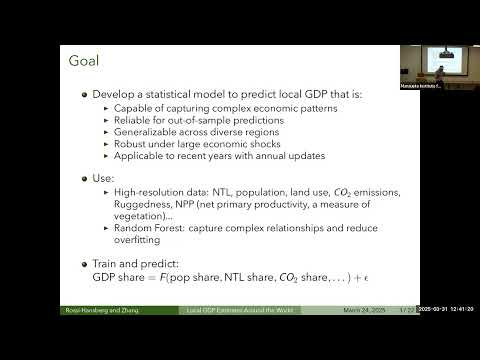 1:00:56
Esteban Rossi-Hansberg
 0:51
0:51 1:12
1:12Abba Lerner
 6:22
6:22Abba Lerner
 1:18:18
Abba Lerner
 33:18
33:18Abba Lerner