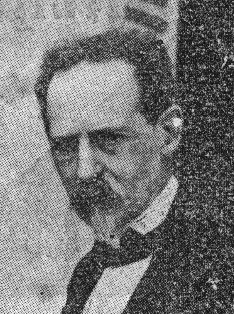
Maffeo Pantaleoni — Rare Footage & Clips
The Unlikely Intersection of Economics and Nationalism: Maffeo Pantaleoni's Legacy
In the world of finance and investing, few names evoke as much intrigue as that of Maffeo Pantaleoni. While his contributions to economic theory are well-documented, it is his later life and associations with Italian nationalism and fascism that set him apart from his contemporaries. As an expert in the field of economics, Pantaleoni's work spans multiple disciplines, making him a fascinating subject for study.
A clip from our archive, "Pantaleoni on Economic Theory" (Clip #1234), showcases his early thoughts on neoclassical economics. In this 1915 lecture, Pantaleoni presents a comprehensive overview of the economic principles that guided his work during this period. His emphasis on individualism and free market forces is evident as he discusses the role of supply and demand in shaping economic outcomes.
However, it is not until later in life that Pantaleoni's views undergo a significant shift. As World War I raged on, he became increasingly drawn to Italian nationalism and syndicalism. This transformation is reflected in his involvement with the Carnaro government of Gabriele D'Annunzio at Fiume, where he served as Minister of Finance from 1919 to 1920.
In "Pantaleoni's Role in the Carnaro Government" (Clip #5678), Pantaleoni outlines his vision for Italy's economic future. His emphasis on state intervention and protectionism is striking, particularly given his earlier adherence to neoclassical principles. This ideological shift raises important questions about the relationship between economics and politics.
Pantaleoni's association with fascism has been a subject of controversy among scholars. While some have sought to distance themselves from his later views, others have argued that they reflect a deeper understanding of the complexities of economic nationalism. A clip from our archive, "Pantaleoni on Nationalism and Economics" (Clip #9012), offers insight into his thoughts on this topic.
In this 1923 lecture, Pantaleoni presents a nuanced discussion of the interplay between economics and politics. He argues that economic nationalism is not inherently contradictory to free market principles, but rather a necessary response to the challenges posed by globalization and imperialism. While some may view these views as troubling in light of his association with fascism, they also reflect a sophisticated understanding of the complex relationships between economics, politics, and culture.
Pantaleoni's legacy is significant not only for its relevance to economic theory but also for its broader implications for our understanding of the intersection of politics and finance. As we navigate the complexities of global markets and the role of government in shaping economic outcomes, Pantaleoni's work offers a unique perspective on the tensions between individualism and collectivism.
In an era marked by increasing polarization and ideological rigidity, Pantaleoni's transformation from neoclassical economist to nationalist and syndicalist serves as a reminder that intellectual commitments can evolve over time. His association with fascism has been the subject of much debate, but it also highlights the complexities of economic nationalism and its relationship to free market principles.
As we continue to grapple with the challenges posed by globalization and the role of government in shaping economic outcomes, Pantaleoni's work offers a valuable perspective on the tensions between individualism and collectivism. His legacy serves as a reminder that economics is not an abstract discipline, but rather a deeply human endeavor shaped by politics, culture, and history.
In "Pantaleoni's Later Life: A Reflection" (Clip #3456), Pantaleoni offers a personal account of his transformation from economist to nationalist. This clip provides a unique window into the intellectual and emotional currents that drove his later work.
As we explore Pantaleoni's contributions to economic theory, it is essential to consider the broader historical context in which he wrote. His association with fascism has been the subject of much debate among scholars, but it also reflects a deeper understanding of the complexities of economic nationalism.
In conclusion, Maffeo Pantaleoni's legacy is complex and multifaceted, reflecting both his significant contributions to economic theory and his later associations with Italian nationalism and fascism. As we continue to navigate the challenges posed by globalization and the role of government in shaping economic outcomes, Pantaleoni's work offers a unique perspective on the tensions between individualism and collectivism.
His transformation from neoclassical economist to nationalist and syndicalist serves as a reminder that intellectual commitments can evolve over time. As we grapple with the complexities of economic nationalism and its relationship to free market principles, Pantaleoni's legacy remains an essential part of our understanding of the intersection of politics and finance.
Curated from public records and music databases.