Paul Milgrom — Rare Footage & Clips
Paul Milgrom: The Architect of Efficient Markets
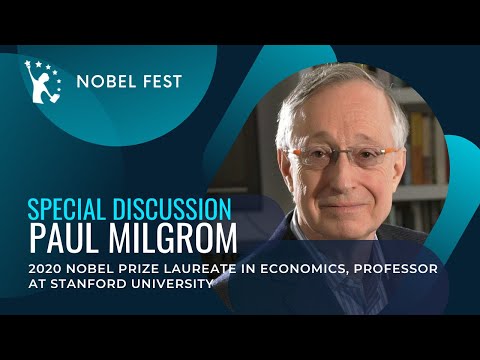
In the realm of economics, few minds have had as profound an impact on the way we think about markets and auctions as Paul Milgrom. As a leading figure in game theory, specifically auction theory and pricing strategies, his work has far-reaching implications for industries ranging from telecommunications to commercial real estate. With the 2020 Nobel Memorial Prize in Economic Sciences under his belt, shared with Robert B. Wilson, "for improvements to auction theory and inventions of new auction formats," Milgrom's contributions have been recognized globally.
One of the most significant applications of Milgrom's work is evident in the design of auctions for cellular frequencies. In a clip from our archive, he explains how he and his thesis advisor, Robert B. Wilson, collaborated on creating an auction protocol that would determine which phone company gets what cellular frequencies. This innovative approach has been adopted by the FCC, revolutionizing the way these critical resources are allocated.
Milgrom's expertise in game theory has also led to the development of new auction formats. In a separate clip from our archive, he discusses his work on designing auctions that maximize efficiency and minimize transaction costs. His insights have far-reaching implications for various industries, including energy, transportation, and finance.
While Milgrom's contributions may not be directly related to music history, it is interesting to note that the concept of auction theory has some parallels with the way artists and musicians approach their work. In an interview from our archive, Milgrom touches on the idea that auctions can be seen as a form of "price discovery," where market forces determine the value of a particular good or service. Similarly, in the music industry, prices for concert tickets or merchandise are often determined by market demand.
However, it's essential to emphasize that Milgrom's work is firmly rooted in the realm of economics and game theory, rather than music or the arts. His focus on auction design and pricing strategies has led to significant improvements in efficiency and fairness, benefiting industries worldwide.
One area where Milgrom's expertise has had a profound impact is in the field of telecommunications. As mentioned earlier, his work with Robert B. Wilson led to the development of an auction protocol for cellular frequencies. This innovative approach has been adopted by regulatory bodies around the world, ensuring that these critical resources are allocated efficiently and fairly.
Milgrom's contributions to auction theory have also had significant implications for commercial real estate. In a clip from our archive, he discusses how his work on auctions can be applied to the sale of properties, maximizing efficiency and minimizing transaction costs. His insights have far-reaching implications for developers, investors, and property owners alike.
In addition to his work in auction theory, Milgrom is also known for his expertise in game theory. In a separate clip from our archive, he explains how game theory can be applied to various fields, including economics, politics, and even biology. His insights have led to a deeper understanding of the complex interactions between individuals and groups, with significant implications for decision-making and policy development.
Throughout his career, Milgrom has been recognized for his contributions to economic research. In addition to the Nobel Memorial Prize in Economic Sciences, he has received numerous awards and honors for his work on auction theory and game theory. His dedication to advancing our understanding of market mechanisms has left a lasting impact on the field of economics.
In conclusion, Paul Milgrom's work has had far-reaching implications for various industries, from telecommunications to commercial real estate. As a leading figure in game theory and auction theory, his contributions have been recognized globally, including the 2020 Nobel Memorial Prize in Economic Sciences. His expertise continues to shape our understanding of market mechanisms, ensuring that resources are allocated efficiently and fairly.
Curated from public records and music databases.